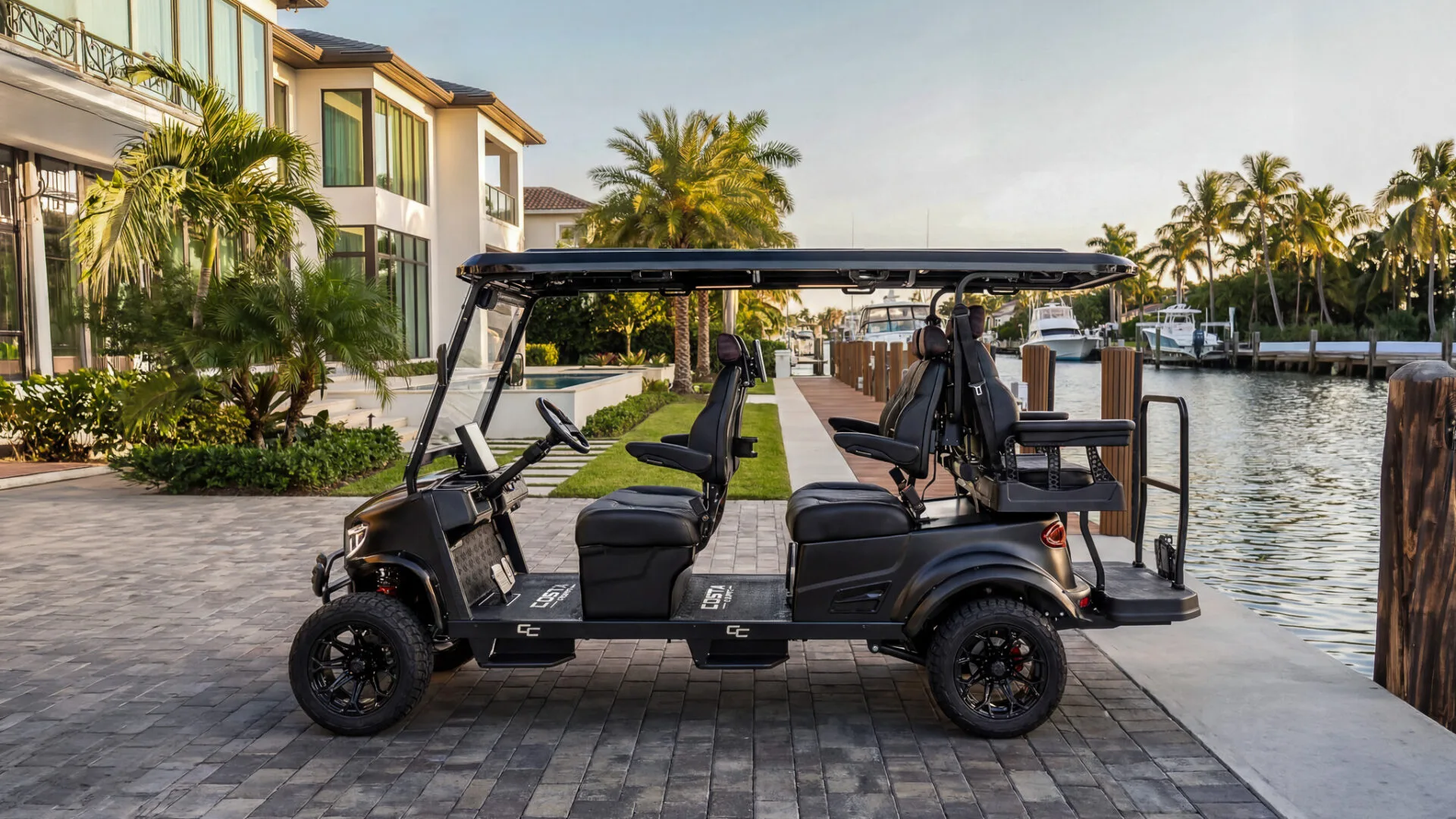
From Driveway to Dock: How People Are Using Golf Carts Beyond the Course
Ask someone who’s owned a golf cart for a year what they actually use it for, and golf will be somewhere near the bottom of the list — if it makes the list at all. Somewhere along the way, the golf cart quietly stopped being a piece of golf equipment and became something much more useful: a genuine lifestyle vehicle that handles the entire span of daily life, from the coffee run that starts the morning to the sunset drive down to the water that ends the day.
That shift is the whole story here. Golf carts for lifestyle use have become one of the most versatile things you can park in a Florida garage, and the range of what people do with them is far wider than most buyers expect going in. The course is now the one place a lot of these carts never go.
Here’s what that versatility actually looks like, across the full spectrum from driveway to dock.
The Everyday End of the Spectrum
The uses that end up mattering most are the unglamorous ones — the small, repeating errands that make up the texture of a week. The grocery run. The pharmacy pickup. Dropping a kid at a friend’s house two streets over. Grabbing takeout from the restaurant near the marina. Retrieving a package from the community mailboxes. None of these are exciting, and that’s exactly the point: a cart absorbs the constant low-level friction of short trips that a car handles inefficiently and walking handles too slowly.
What changes the equation is how little effort each of these trips takes once a cart is involved. There’s no warming up, no backing out of a garage, no hunting for parking at the other end. You step in and go, and because going is easy, you find yourself combining errands and running out for small things you’d otherwise batch or skip entirely. Families feel this most acutely. Kids who are old enough to ride along suddenly want in on every trip, and a mundane run to pick up dinner turns into something the whole household does together. Pets ride along too — the cart is an easy way to take a dog to the park or along on the loop through the neighborhood.
For anyone living on a larger property, an estate, or acreage, the everyday utility extends further still — moving tools, hauling supplies, checking the far end of the property, carrying guests from the drive to the door. The cart becomes the vehicle you reach for whenever the task is bigger than walking but smaller than the car.
The Social and Leisure Side
Move a little further along the spectrum and the golf cart becomes something people use purely because it makes life more enjoyable. This is where it stops being a tool and starts being part of how a household spends its time.
Entertaining is a big part of it. In coastal and golf-cart communities, the cart is how people move between neighbors’ homes for dinners and gatherings, how they get to and from community events without dealing with parking, and how they show up to the farmers market, the food-truck night, or the waterfront festival. There’s a social visibility to a cart that a car doesn’t have — you’re out in the open, you wave, you stop for a two-minute conversation with someone you’d otherwise just drive past. The cart pulls you into the life of a community rather than sealing you off from it.
And then there’s the leisure use that has no purpose beyond itself: the evening drive. The unhurried loop through the neighborhood at golden hour, coffee or a drink in hand, no destination in particular. Owners of premium electric carts describe this as one of the things they reach for most — a drive that exists simply because it feels good to take. The open air, the quiet of an electric drivetrain, the pace that matches how an evening is supposed to move. It’s the kind of small ritual that ends up defining what people love about cart ownership, and it has nothing to do with getting anywhere.
All the Way to the Water
At the far end of the spectrum — the dock end — the golf cart earns its keep in a way that’s specific to waterfront living. For boaters and residents of marina communities, the cart is the connective tissue between the house, the slip, and everything in between. Hauling coolers, gear, groceries, and passengers from a parking area down to a boat is a task a car can’t do and that doing on foot gets old fast, especially in the Florida heat. A cart makes it effortless, and for anyone who’s out on the water regularly, it becomes an inseparable part of the routine within the first few weeks.
Electric carts are particularly at home here. They’re quiet enough not to intrude on the early-morning calm of a marina, they produce no exhaust around fuel docks and enclosed dock areas, and their simpler drivetrains hold up better against salt air over the long run than a gas engine does. The waterfront is where the case for an electric lifestyle cart is at its most obvious — which is exactly why so many of them end up living near the water.
What Makes a Cart Actually Good at All of This
Here’s the honest part: not every golf cart is up to this range of use. A basic cart built for the course and lightly adapted for the road will do some of these things adequately and none of them particularly well. The versatility that makes a cart genuinely worth owning across the whole driveway-to-dock spectrum comes from how it’s built — and that’s where the gap between a basic cart and a purpose-built one shows up fast.
Range is the first thing that determines whether a cart can actually serve as a lifestyle vehicle rather than a short-hop novelty. A cart you have to think about charging, or that leaves you calculating whether you’ll make it back, quietly gets used less. Costa Carts are built with a 64V 230Ah lithium battery system rated for up to 100 miles on a single charge — enough that range simply stops being a consideration in daily use. You plug in overnight and drive without thinking about it, the same way you charge a phone.
The rest of it is about whether the cart is comfortable and capable enough that you actually want to use it for everything. The 4-wheel independent suspension with a 2.5-inch lift and hydraulic disc brakes on both the 400LF and 600L mean the cart handles varied terrain — neighborhood roads, gravel paths, dock approaches — with genuine composure rather than transmitting every bump to the people in it. The four-passenger 400LF suits most households; the six-passenger 600L handles larger families, more guests, and bigger properties. And the details that make daily use pleasant rather than merely functional are standard:
- Apple CarPlay and Android Auto for navigation and music
- A backup camera for tight spaces
- A premium audio system for the evening drive
- Quality seating for the long way home
These come standard because Costa builds these as complete vehicles meant for real coastal life, not as golf equipment with a windshield added.
That’s ultimately what “beyond the course” means. The best lifestyle carts were never really designed for the course in the first place. They were designed for the life that happens everywhere else — and that life runs all the way from the driveway to the dock.
People Also Ask
What do people use golf carts for besides golf?
Far more than golf. Common uses include grocery and errand runs, school and neighbor drop-offs, beach and marina trips, community events and entertaining, farmers markets, carrying pets, moving around larger properties, and leisurely evening drives. For many owners, golf is the one thing they rarely use the cart for.
Are golf carts practical for everyday life?
Yes — particularly in Florida communities, coastal neighborhoods, and mixed-use developments where daily life happens within a compact radius. A quality electric cart with sufficient range and comfort removes the friction from short trips and often gets used far more than an owner initially expects.
What makes a golf cart good for lifestyle use rather than just golf?
Range, comfort, build quality, and capability. A cart needs enough range to be used without charging anxiety, suspension and braking that handle varied terrain comfortably, and features that make regular use pleasant. Purpose-built carts like the Costa 400LF and 600L are engineered for this breadth of use rather than adapted from course carts.
Can you use a golf cart at a marina or on the waterfront?
Absolutely. Carts are ideal for moving gear, coolers, and passengers between parking areas and boat slips. Electric models are especially well-suited to waterfront use — they’re quiet, produce no exhaust around docks, and their simpler drivetrains resist salt-air corrosion better than gas engines. Always confirm your specific marina’s rules on cart access.
How far can a lifestyle golf cart travel on one charge?
The Costa Carts 400LF and 600L are both rated for up to 100 miles per charge on a 64V 230Ah lithium battery system — far more than typical daily lifestyle use requires, which means charging becomes a simple overnight routine rather than a daily concern.
How many people can ride in a lifestyle golf cart?
It depends on the model. The Costa 400LF seats four, which suits most households and everyday use. The six-passenger 600L is better for larger families, frequent entertaining, or anyone who regularly carries more people or gear.
Recent Posts

Golf Cart Apple CarPlay 13 Inch Display: Complete Guide

Golf Cart Anti-Theft Ignition Safety: Prevent LSV Theft

Florida Street Legal LSV Regulations Guide | Costa Carts

DOT Requirements for Street-Legal Low-Speed Vehicles (LSVs)

Costa Carts 600 vs Yamaha Concierge & Denago Rover XL