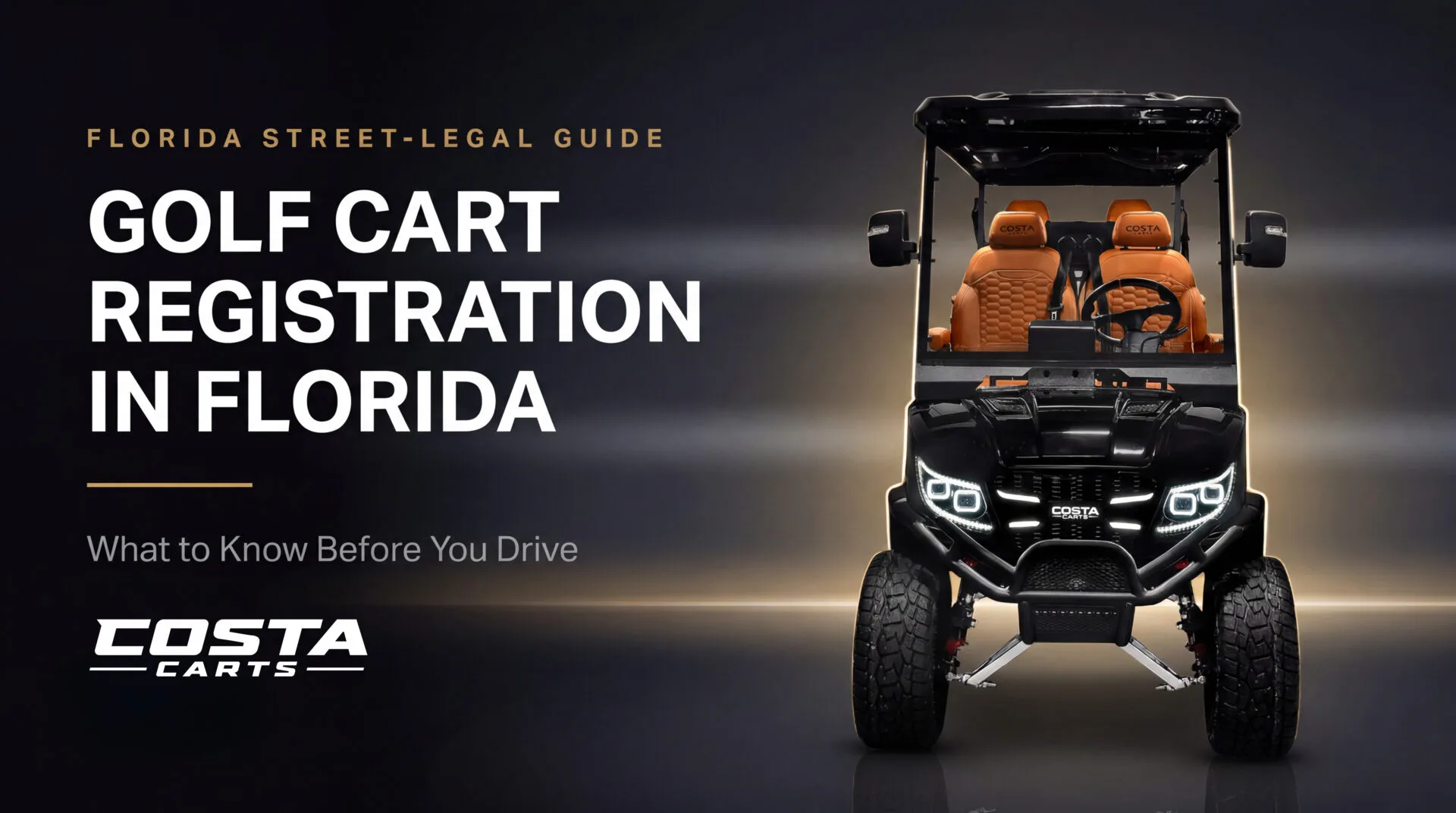
Golf Cart Registration Florida: What You Need to Know Before You Drive
Whether you need to register your cart in Florida comes down to a single question: is it legally a “golf cart” or a “low-speed vehicle”? The answer changes everything. A true golf cart doesn’t get titled, registered, or insured with the state. A low-speed vehicle — which is what most street-legal carts actually are, including every cart Costa Carts builds — must be titled, registered, and insured, and the driver needs a valid driver’s license. Getting this distinction right before you buy or drive is what keeps you legal and protected.
That sounds like a technicality. It isn’t. Under Florida law these are two separate vehicle classifications with two completely different sets of rules, and the line between them is drawn at a specific speed. Most buyers assume “golf cart” means “no paperwork.” For the kind of cart most people actually want — one they can drive around their community on real roads — that assumption is usually wrong, and the difference matters for your title, your insurance, and your liability if something goes wrong.
Here’s how the law actually works, what registration involves, and what to confirm before you drive.
The Distinction That Determines Everything
Florida defines a golf cart and a low-speed vehicle separately, and the dividing line is top speed.
A golf cart, under Section 320.01(22), Florida Statutes, is “a motor vehicle that is designed and manufactured for operation on a golf course for sporting or recreational purposes and that is not capable of exceeding speeds of 20 miles per hour.” Because the state doesn’t classify a true golf cart as a registerable motor vehicle, golf carts are not required to be titled or registered and, therefore, are not required to be insured with PIP and PDL insurance coverage. A golf cart can be operated on roadways that are designated for golf carts with a posted speed limit of 30 mph or less, assuming the local government has approved that road for cart use and posted the appropriate signs.
A low-speed vehicle is a different animal. Section 320.01(41), Florida Statutes, defines LSVs as “any four-wheeled vehicle whose top speed is greater than 20 miles per hour, but not greater than 25 miles per hour.” And the consequences of that classification are significant: LSVs must be registered, titled and insured with personal injury protection (PIP) and property damage liability (PDL) insurance. Any person operating an LSV must have a valid driver license in their immediate possession. An LSV also has a broader operating range than a golf cart — LSVs may be operated only on streets where the posted speed limit is 35 MPH or less.
This is the part that catches buyers off guard. Even unmodified golf carts rated for 20–25 mph by the manufacturer may already meet the LSV definition. If the cart you’re looking at can exceed 20 mph, Florida treats it as a low-speed vehicle whether the seller calls it a “golf cart” or not — and the registration, title, and insurance obligations apply in full.
Costa Carts fall on the LSV side of that line by design. Both the 400LF and the 600L have a top speed of up to 25 mph, which means they are low-speed vehicles under Florida law, not golf carts. If you own a Costa — or any street-legal cart that can travel faster than 20 mph — you are required to title, register, and insure it, and you need a valid driver’s license to operate it on public roads. That isn’t a downside; it’s exactly what makes the cart genuinely street-legal rather than confined to a handful of posted neighborhood lanes. But it does mean there’s a process, and it’s worth understanding before you drive off.
What Registering an LSV in Florida Actually Requires
The good news for anyone buying a factory-built LSV like a Costa is that the cart already arrives as a completed, compliant low-speed vehicle. It comes with a Manufacturer’s Certificate of Origin and a 17-digit VIN, and it’s built to the federal safety standard for low-speed vehicles (FMVSS No. 500, 49 CFR 571.500). That matters because it means you’re titling and registering a new motor vehicle in the ordinary way — not going through the separate inspection-and-VIN-assignment process that Florida requires when someone converts an old sub-20-mph golf cart into an LSV.
To title and register an LSV in Florida, you’ll generally need:
- The Manufacturer’s Certificate of Origin (or the title, if it’s a used cart)
- Proof of Florida insurance meeting the state minimums
- Valid identification
- Payment of the applicable fees
LSVs must be titled and registered with the Florida DHSMV. You will need a Manufacturer’s Certificate of Origin or a title, proof of Florida PIP and PDL insurance, and a valid Florida driver’s license. On the insurance side, Florida requires $10,000 PIP and $10,000 PDL for LSV-classified golf carts on public roads, which mirrors the minimum no-fault coverage required of any registered motor vehicle in the state. You can’t complete registration without the insurance in place first.
In practice, the dealer you buy from will often handle or walk you through the titling and registration paperwork, much as a car dealership does — providing the Manufacturer’s Certificate of Origin and helping process the title application so you leave with a clear path to a plate. It’s worth asking any dealer directly how they handle this, because a reputable one will make the registration process straightforward rather than leaving you to navigate it alone. If you’re buying privately or out of state, you’ll be managing the title transfer and registration yourself through your county tax collector or license plate agent.
One note specifically for anyone considering a used cart that was converted from a golf cart rather than built as an LSV from the factory: if a golf cart has been modified to an LSV, the registration and title date do not reflect the manufacture date (age of the vehicle); instead, it indicates the year it was registered and titled, which means the cart could be older than the title suggests. That’s a meaningful thing to verify before you buy used.
Who Can Legally Drive
Florida’s licensing rules differ depending on whether you’re operating a golf cart or an LSV, and the rules tightened in recent years.
For a true golf cart on public roads, a 2023 law (HB 949, effective October 1, 2023) raised the bar. Beginning October 1, 2023, a person operating a golf cart on public roads or streets who is under 18 years of age must possess a valid learner’s driver license or valid driver license, and a person 18 or older must carry valid government-issued photo identification. In practical terms, that change raised the minimum age for golf cart operation on public roads from 14 to 15 (with a learner’s permit) or 16 (with a driver’s license).
For an LSV, the rule is simpler and stricter: because an LSV is legally treated as a motor vehicle, the driver must have a valid driver’s license — full stop, regardless of age. Since a Costa is an LSV, anyone driving it on public roads needs a valid driver’s license in their possession, the same as they would behind the wheel of a car.
It’s also worth knowing that Florida’s impaired-driving law doesn’t exempt either category. Florida Statute 316.193 applies to any motor vehicle, and golf carts qualify; if you’re operating a golf cart on a public road while under the influence of alcohol or drugs, you can be charged with a DUI, under the same 0.08 BAC threshold that applies to cars. The cart’s relaxed, recreational character doesn’t change the legal seriousness of operating it impaired.
Local Rules Still Matter
State law sets the floor, not the ceiling. Florida gives counties and municipalities meaningful authority over where carts can operate, and those local rules can be more restrictive than the statewide baseline. The operation of golf carts on roads must comply with any more restrictive ordinances enacted by local government and should be verified prior to operating these vehicles. A road that’s open to carts in one community may be off-limits a few miles away, and some coastal municipalities haven’t passed the ordinances needed to authorize cart use on local streets at all.
This is why the final step before you drive isn’t a statute — it’s a phone call. Confirm with your city or county how cart and LSV use is handled on the specific roads you intend to drive, and if you live in an HOA or deed-restricted community, check the community’s own rules as well, since those frequently add requirements of their own. The registration gets you legal with the state. Local verification gets you legal where you actually live.
None of this is meant as legal advice, and rules genuinely do change and vary by locality. For the authoritative current requirements, the Florida Department of Highway Safety and Motor Vehicles (flhsmv.gov) and your local government are the sources to rely on. But the framework above is the one that governs nearly every street-legal cart purchase in Florida today — and for a cart like a Costa, the path is clear: it’s an LSV, it gets titled, registered, and insured, and once it is, you have a vehicle you can legally drive across your community rather than one confined to a cart path.
People Also Ask
Do you have to register a golf cart in Florida?
It depends on the cart’s top speed. A true golf cart — one incapable of exceeding 20 mph — does not need to be titled, registered, or insured with the state. A low-speed vehicle, which can travel 20–25 mph, must be titled, registered, and insured. Most street-legal carts, including all Costa Carts models, are LSVs and therefore require registration.
What’s the difference between a golf cart and a low-speed vehicle in Florida?
The dividing line is top speed. Under Florida Statute 320.01, a golf cart cannot exceed 20 mph, while a low-speed vehicle has a top speed between 20 and 25 mph. LSVs must be registered, titled, and insured and require a licensed driver; golf carts have no such state requirements but are limited to roads posted at 30 mph or less that have been designated for cart use.
How much does it cost to register an LSV in Florida?
Costs include a title fee, registration fee (which varies by vehicle weight), a plate fee, and Florida’s initial registration fee where applicable. Exact amounts are set by the state — current fee schedules are available at flhsmv.gov/fees. You’ll also need an active insurance policy in place before registering.
Do you need insurance for a golf cart in Florida?
A true golf cart used only on designated roads is not required by the state to carry insurance, though it’s strongly recommended and some local governments require it. An LSV must carry the state minimum of $10,000 in personal injury protection (PIP) and $10,000 in property damage liability (PDL), the same as any registered motor vehicle.
Do you need a driver’s license to drive a golf cart or LSV in Florida?
For an LSV, yes — a valid driver’s license is always required because it’s treated as a motor vehicle. For a true golf cart on public roads, a driver under 18 must have a valid learner’s permit or driver’s license, and a driver 18 or older must carry valid government-issued photo identification.
Are Costa Carts considered golf carts or LSVs in Florida?
Costa Carts are low-speed vehicles. Both the 400LF and 600L have a top speed of up to 25 mph, which places them above the 20 mph golf cart threshold. That means they must be titled, registered, and insured, and they can be legally driven on Florida roads posted at 35 mph or less.
Can I drive my LSV on any road in Florida?
No. LSVs may only be operated on streets with a posted speed limit of 35 mph or less, and local ordinances can impose additional restrictions. Always confirm with your city or county which specific roads permit LSV operation before driving.
Recent Posts

Golf Cart Apple CarPlay 13 Inch Display: Complete Guide

Golf Cart Anti-Theft Ignition Safety: Prevent LSV Theft
Florida Street Legal LSV Regulations Guide | Costa Carts
DOT Requirements for Street-Legal Low-Speed Vehicles (LSVs)

Costa Carts 600 vs Yamaha Concierge & Denago Rover XL