Safety, Comfort, and Tech: What Modern Buyers Expect in a Golf Cart
There’s a version of the golf cart conversation that still happens in dealerships sometimes, where a buyer walks in expecting a slightly nicer version of what they rode in at a resort fifteen years ago — a padded bench, a plastic windshield, a speed dial, and not much else. Then they sit in a current model and the conversation changes entirely.
The golf cart category has moved. Significantly, and in a relatively short window of time. What buyers in 2026 expect from a quality electric cart — and what the best manufacturers actually deliver — would have been difficult to imagine as standard equipment a decade ago. The gap between basic and premium isn’t a matter of comfort upgrades anymore. It’s a fundamental difference in how the product is conceived, what it’s built to do, and who it’s built for.
Understanding what modern buyers are actually looking for, and how current technology addresses those expectations, is worth going through carefully — because the features that matter most aren’t always the ones that get the most attention in marketing materials.
Safety as Foundation, Not Afterthought
Street-legal certification establishes a baseline — headlights, brake lights, turn signals, mirrors, windshield, seatbelts, VIN. Every street-legal cart must meet these minimums. But the difference between a cart that satisfies the regulatory floor and one that was engineered with safety as a design priority shows up quickly in real-world use.
Braking is where this is most immediately apparent. Hydraulic disc brakes on all four wheels — standard on both the Costa 400LF and 600L — provide consistent, progressive stopping power under repeated use, including on the wet roads, sandy approaches, and dock surfaces that Florida coastal driving regularly involves. Drum brakes, which remain common on less engineered carts, are adequate in ideal conditions and increasingly less so as conditions change or usage accumulates. The difference between the two isn’t theoretical. It’s felt every time you need to stop decisively and the cart responds exactly as expected.
The suspension architecture matters for safety as well as comfort. Independent suspension on all four wheels means the cart remains stable and predictable when one corner encounters an uneven surface — a dock approach, a road edge, a parking lot transition. A cart with solid axles transfers road disturbance across the vehicle in ways that affect steering response and occupant stability. Independent suspension isolates those inputs, keeping the chassis composed and the driver in control. On a vehicle that families use for daily transportation, this isn’t a performance feature in the sports car sense. It’s a safety characteristic with real-world consequences.
The 2026 Costa lineup added a waterproof LED push-to-start and app-controlled LED speaker ring lights, and while neither is a safety specification in the traditional sense, both reflect the engineering discipline that extends across the product. Waterproof electrical components in a vehicle used in Florida’s rain, humidity, and salt air aren’t a luxury — they’re protection against the failure modes that compromise reliability and, by extension, safety over time.
Comfort as a System, Not a Feature List
Comfort on a golf cart is easy to oversimplify. Better seats, a smoother ride, a nicer interior — these are real improvements, but they describe individual attributes rather than the experience of comfort as something integrated and coherent.
The most important comfort element in a modern electric cart is ride quality, and ride quality is a function of the entire chassis system working together. The 4-wheel independent suspension with a 2.5-inch lift gives the 400LF and 600L the ground clearance to handle varied terrain without bottoming out, while the adjustable rear shocks introduced in the 2026 models allow owners to tune the suspension character to their preference and their typical load. A couple who primarily uses their cart for smooth neighborhood roads wants a different suspension setup than an owner who regularly crosses gravel paths and dock approaches. The ability to adjust this means the cart can be optimized for the life you’re actually living.
The adjustable and telescopic steering column is a detail that buyers often undervalue until they’ve driven a cart without one. Reach and tilt adjustability means the driver’s position can be set correctly regardless of their height — and a correct driving position reduces fatigue on longer drives in ways that accumulate meaningfully over regular daily use. It also matters for passenger comfort in the front seat, where a poorly positioned steering column restricts entry and exit in ways that become annoying quickly.
Adjustable armrests, gas struts under the seat bottoms for easy storage access, interior courtesy lighting and a glove box light, Costa-branded storage covers — each of these is a modest individual item. Together they compose an interior environment that communicates care in construction and makes regular use more comfortable in the small ways that turn a cart you appreciate into a cart you prefer over everything else.
The cabin noise level deserves mention here too. Silent electronic power steering, a near-silent drivetrain, and a build quality that minimizes rattles and resonance combine to create an acoustic environment inside the cart that is genuinely calm. This matters more on longer drives and in environments where the ambient sound around you — the water, the neighborhood, a conversation with a passenger — is part of why you’re taking the drive at all.
Technology That Supports the Drive
The technology package in a current premium electric cart has no real predecessor in the category from a decade ago. What’s now available as standard equipment on a Costa reflects an integration philosophy where technology is meant to enhance the ownership experience without becoming the point of it.
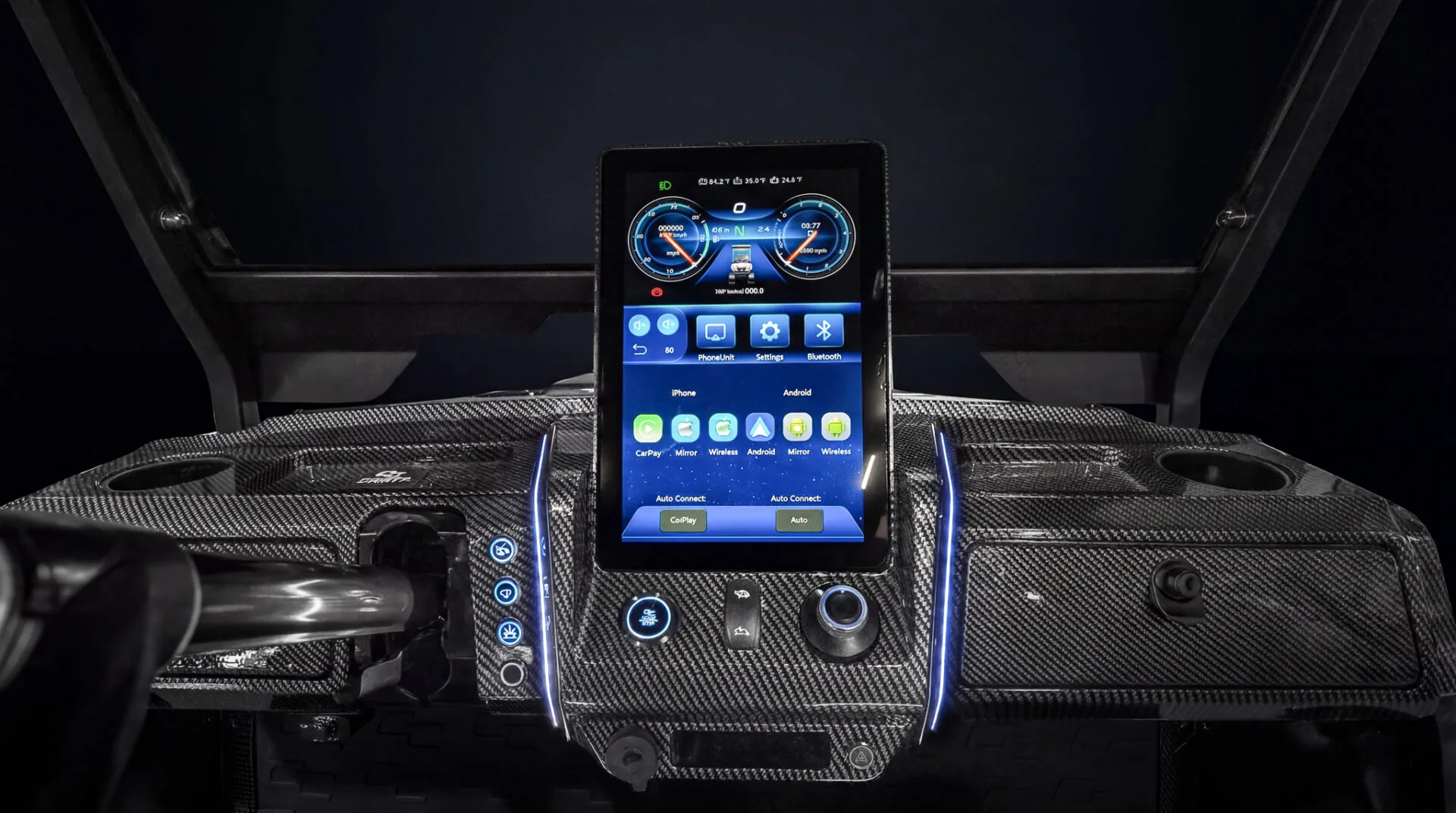
Both the 400LF and 600L are equipped with a 13-inch vertical in-dash display and a separate 13-inch Android rear display, Apple CarPlay and Android Auto connectivity, USB and USB-C ports, a backup camera, and a premium amplified audio system. The 400LF includes a 10-inch subwoofer; the 600L pairs its subwoofer with a six-speaker amplified system. These aren’t amenities bolted onto a basic cart. They’re the standard configuration, integrated into the design from the beginning.
Apple CarPlay and Android Auto matter specifically because they solve a navigation and connectivity problem that affects daily cart use in a way most buyers don’t think to ask about until they’re in the cart. Getting directions to an unfamiliar marina, playing music on a sunset drive, managing a call without picking up a phone — these are things that happen on cart trips the same way they happen in car trips, and having a native, integrated solution for them is meaningfully better than a suction-cup phone mount on a basic dash.
The backup camera is a safety and convenience feature that earns its keep every single time you reverse out of a tight parking space, a dock-adjacent slot, or a narrow driveway. In community and resort environments where pedestrian traffic is part of the landscape, rear visibility matters in ways that rear mirrors alone don’t fully address.
The app-controlled LED speaker ring lights are the kind of feature that sounds like a novelty on paper and becomes something owners actually use regularly. Exterior ambient lighting that can be tuned from a phone isn’t purely decorative — it makes the cart more visible at dusk, more distinctive in resort or event environments, and more enjoyable to live with as a product that reflects personal taste.
The temperature-adjustable controller cooling fan, also new in 2026, is a technical detail with longevity implications. The motor controller is one of the higher-value components in the drivetrain. Active thermal management keeps it operating in its optimal temperature range, protecting both performance and component life over years of use in Florida’s heat. It’s not a feature buyers ask about at the point of purchase. It’s a feature they benefit from quietly over the life of the cart.
What the Best Products Get Right
The difference between a cart with good individual features and a cart that feels genuinely good to use every day is whether those features were designed to work together as a system. A smooth drivetrain paired with a poorly tuned suspension. A beautiful interior paired with a steering column that doesn’t adjust. A premium audio system paired with a dash that vibrates at highway speed. Individual wins that undermine each other don’t add up to a satisfying ownership experience.
Costa’s design philosophy — described on their own experience page as engineering the cart as a complete system, not an assembly of parts — is what separates the product from competitors who approach feature content as a checklist. The 400LF and 600L earn their positioning not because they have more items on the specification sheet, but because the items on that sheet were selected and implemented with a coherent understanding of what the ownership experience should feel like. That coherence is what modern buyers are ultimately looking for, even when they can’t articulate it in those terms. They know it when they sit down, drive, and don’t have to think about what’s wrong.
People Also Ask
What safety features should a modern golf cart have?
Street-legal certification requires headlights, brake lights, turn signals, mirrors, windshield, and seatbelts as a minimum. Beyond that, hydraulic disc brakes, independent suspension, and waterproof electrical components significantly improve real-world safety and reliability.
What technology comes standard on Costa Carts?
Both the 400LF and 600L include dual 13-inch displays, Apple CarPlay and Android Auto, USB and USB-C ports, a backup camera, a premium amplified audio system with a 10-inch subwoofer, and app-controlled LED speaker ring lights as standard equipment.
What suspension does a modern premium golf cart use?
The Costa Carts 400LF and 600L use 4-wheel independent suspension with a 2.5-inch lift and adjustable rear shocks, allowing each wheel to respond independently to road surfaces for a more composed, comfortable, and stable ride.
Why does golf cart comfort matter for daily use?
Carts used regularly for neighborhood errands, community transportation, and lifestyle driving accumulate significant mileage over time. Adjustable steering, proper suspension, quality seating, and low cabin noise reduce fatigue and make daily use genuinely enjoyable rather than merely functional.
Do modern electric golf carts have Apple CarPlay?
Yes. Both the 2026 Costa Carts 400LF and 600L come standard with Apple CarPlay and Android Auto integration through a 13-inch vertical in-dash display.
What is a backup camera on a golf cart used for?
A backup camera provides rear visibility when reversing — particularly valuable in community environments, tight parking situations, dock approaches, and resort settings where pedestrians and obstacles are common. Both Costa models include a backup camera as standard equipment.
Recent Posts

Golf Cart Apple CarPlay 13 Inch Display: Complete Guide

Golf Cart Anti-Theft Ignition Safety: Prevent LSV Theft

Florida Street Legal LSV Regulations Guide | Costa Carts

DOT Requirements for Street-Legal Low-Speed Vehicles (LSVs)

Costa Carts 600 vs Yamaha Concierge & Denago Rover XL