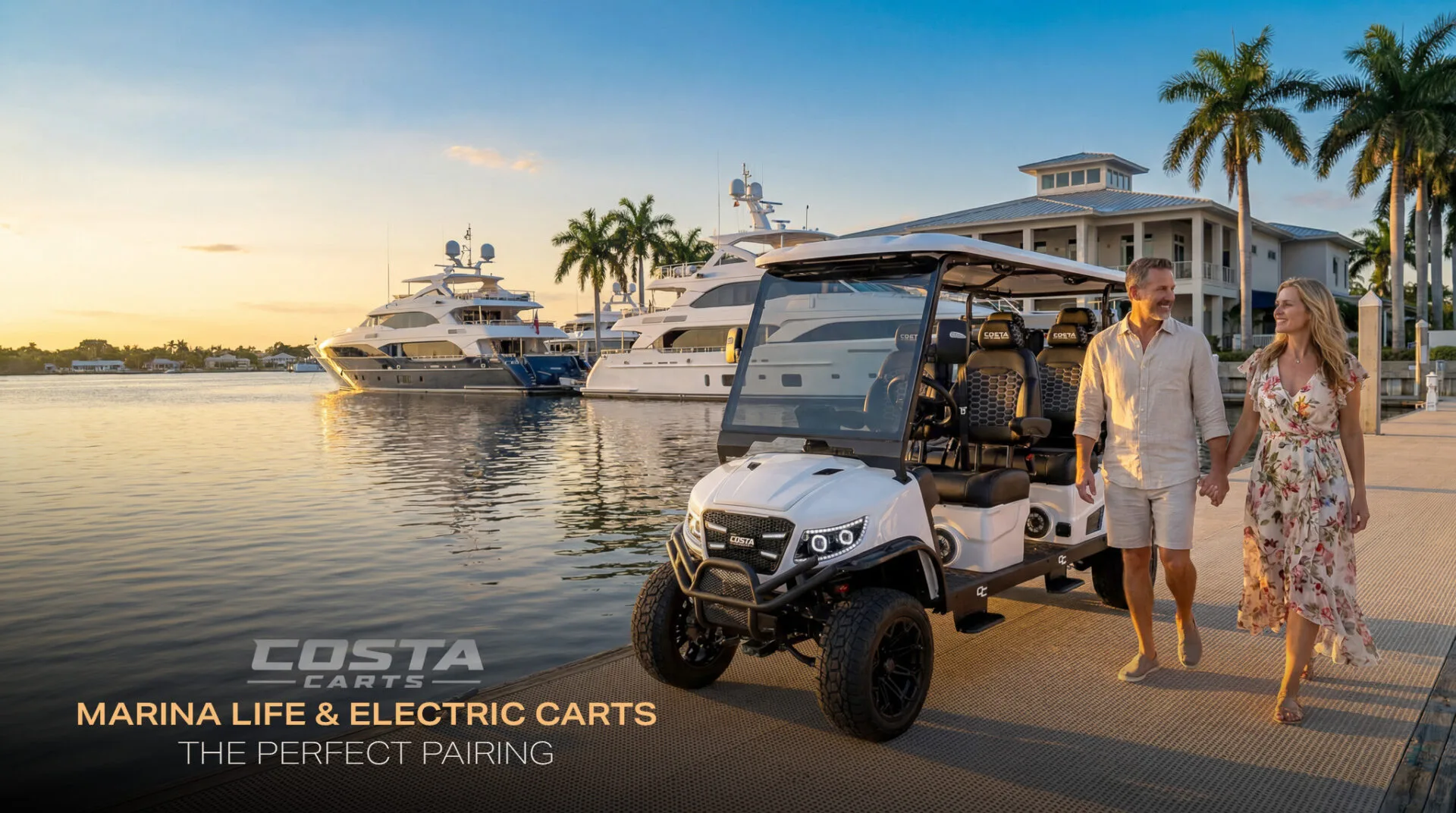
Marina Life and Electric Carts: The Perfect Pairing
There’s a particular rhythm to life around a marina. Mornings start early — coffee before the light is fully up, a walk down to check on the boat, maybe a conversation with whoever else is already at the dock. Afternoons slow down. Evenings have a quality you don’t find anywhere else, especially when the water is catching the last hour of sun and the air has that specific salt-and-diesel smell that people who live near marinas either love immediately or never quite understand.
The golf cart fits into this rhythm in a way that almost nothing else does. Not as a novelty. As the obvious choice.
If you’ve spent any time at a marina property, a waterfront community, or a coastal neighborhood where the dock is as much a destination as the house, you’ve probably already noticed that carts are everywhere. What’s worth understanding is why that is — and why the electric versions specifically have become the dominant choice in these environments.
The Practical Case Is Straightforward
Marina environments have a geography that makes golf carts genuinely useful in ways that go beyond lifestyle preference. The distances between things — the parking area and the dock, the dock and the ship’s store, the boat slip and the nearest restaurant or market — tend to fall in that awkward range where walking is technically possible but inconvenient, and driving a full-size vehicle is technically possible but overkill. A golf cart occupies exactly that middle space.
Dock access specifically is where carts earn their keep. Moving gear, groceries, coolers, fishing equipment, or passengers from a parking area to a slip — especially across the kind of long, open dock infrastructure that characterizes larger marinas — is a task that a car can’t do and that doing on foot becomes tedious quickly. A cart handles it effortlessly. You load up, drive down, unload, and the day starts without the part where you’re making three trips with heavy bags in the Florida heat.
For boaters who go out regularly, this stops being a nice-to-have within the first few weeks. It becomes part of the routine in the same way the cart itself becomes part of the routine — so integrated into how you move that you stop thinking about it as a tool and start thinking of it as simply how things work.
Why Electric Makes the Most Sense Here
The marina environment has specific characteristics that make electric carts a significantly better fit than gas alternatives, and it goes deeper than the general preference for quiet operation.
Salt air is corrosive. Everything in a marina environment — hardware, electronics, mechanical systems — takes more punishment from the environment than it would inland. A gas engine introduces additional mechanical complexity that has to coexist with that corrosive environment: fuel systems, carburetors, oil, belts, and filters all exposed to salt air over years of use. Electric drivetrains are mechanically simpler, with fewer exposed components that the environment can work on. A well-built electric cart at a coastal marina will outlast a comparable gas cart in that specific environment, often by a meaningful margin.
The noise consideration matters more in a marina setting than almost anywhere else. A marina at six in the morning has a particular quiet to it — the creak of lines, water moving under docks, the occasional engine turning over in the distance. It’s an environment people choose partly because of how it sounds. Introducing a small gas engine into that setting isn’t catastrophic, but it’s unnecessary friction. An electric cart moves through the same space without adding anything to the auditory environment. You arrive at the dock the same way the day begins — quietly, without announcement.
Fumes are a real consideration too. Gas carts running near fuel docks, aboard enclosed areas, or in covered parking structures at marina properties create exhaust that electric carts simply don’t produce. In enclosed or semi-enclosed dock environments, this matters for comfort and safety alike.
The Waterfront Community Context
For residents of waterfront communities and marina neighborhoods — not just boaters but anyone living in the coastal corridor between their home and the water — the electric cart has become the connective tissue of daily life in a way that’s hard to fully appreciate until you’re living it.
The marina itself is often just one node in a larger network of destinations. The seafood market, the waterfront restaurant, the bait shop, the boat ramp, the community dock where people gather in the evenings — in a well-designed waterfront community, these things are connected by roads and paths that a golf cart is perfectly sized for. A cart that can do the marina run in the morning and the sunset drive in the evening and the dinner pickup in between is a cart earning its keep seven days a week.
Costa Carts are built for exactly this context. The 400LF — four passengers, 125 inches long, up to 100 miles of range on a 64V 230Ah lithium battery system — handles everything a coastal household actually needs a cart to do. The 600L extends that to six passengers and a longer platform suited to estates, larger marina properties, and resort environments where carrying capacity and presence both matter. Both models come equipped with the following:
- Apple CarPlay and Android Auto integration
- A premium amplified audio system
- A backup camera
- The kind of build quality that communicates, before you’ve driven a single mile, that this cart was made for environments where details are noticed
The 4-wheel independent suspension with a 2.5-inch lift, 23-inch all-terrain radial tires, and hydraulic disc brakes mean the cart handles marina property terrain — dock approaches, gravel paths, occasional grass crossings — with the composure you’d expect from a vehicle built to a higher standard. These aren’t spec sheet details that live on paper. They’re what the cart feels like when you’re actually using it.
Arriving Is Part of It
There’s something the marina environment rewards that most environments don’t, which is the quality of arrival. How you pull up — what the cart looks like, how it sounds, the overall impression it makes — matters in a context where the community is small, faces are familiar, and what you drive says something about how you approach the life you’ve built.
This isn’t vanity. It’s the natural social dimension of tight-knit waterfront communities where everyone knows everyone. A cart that looks like it belongs in that environment — that has presence without ostentation, quality without excess — is part of fitting into the culture of the place rather than standing apart from it.
Costa’s design philosophy addresses this directly. The brand was created, in their own words, not to compete in the traditional golf cart category but to elevate it. The result is a cart that looks at home alongside well-maintained boats, tasteful waterfront architecture, and the particular aesthetic of coastal Florida living — which has its own visual language that Costa understands and speaks fluently.
If you spend time at a marina and haven’t spent time with an electric cart, the pairing is worth experiencing before you make any other assumptions about whether it fits your life. The answer, for most people in that environment, becomes obvious quickly.
People Also Ask
Are electric golf carts good for marina use?
Yes. Electric carts are quieter, produce no exhaust fumes, and have simpler drivetrains that hold up better in salt-air environments than gas alternatives. They’re particularly well-suited for moving gear between parking areas and dock slips.
How far can an electric golf cart travel at a marina?
The Costa Carts 400LF and 600L both offer up to 100 miles of range per charge on a 64V 230Ah lithium battery system — far more than needed for any typical marina or waterfront community use pattern.
What size golf cart is best for marina and waterfront use?
A four-passenger model like the Costa 400LF handles most household marina needs comfortably. The six-passenger 600L is better suited for larger properties, resort environments, or anyone regularly moving more people or gear.
Can golf carts be used on marina docks?
This depends on the specific marina’s rules and dock construction. Many marinas with wide, reinforced dock structures permit golf cart access to certain areas. Always verify with your marina’s management before driving on dock surfaces.
Do electric golf carts hold up in salt air environments?
Quality electric carts with sealed or protected components handle salt-air environments well. The simpler mechanical design of an electric drivetrain — no fuel system, no engine oil, fewer exposed moving parts — offers a durability advantage over gas carts in coastal conditions.
What features matter most in a marina golf cart?
Range, build quality, all-terrain capability, and passenger capacity are the most important factors for marina use. Cargo-friendly design, reliable braking, and weather-resistant construction matter significantly in a waterfront environment.
“`
Recent Posts

Golf Cart Apple CarPlay 13 Inch Display: Complete Guide

Golf Cart Anti-Theft Ignition Safety: Prevent LSV Theft

Florida Street Legal LSV Regulations Guide | Costa Carts

DOT Requirements for Street-Legal Low-Speed Vehicles (LSVs)

Costa Carts 600 vs Yamaha Concierge & Denago Rover XL