Most buyers approach the golf cart purchase the same way they approach most vehicle purchases — they look at the price tag, compare it to a few alternatives, and decide whether the number feels right. That instinct isn’t wrong. But it misses most of what actually determines the cost of owning a golf cart, because the sticker price is a smaller part of that total than most people expect.
The true cost of ownership unfolds over years, not hours. It’s built from fuel or electricity, maintenance visits, battery replacements, repairs, depreciation, and the cumulative experience of living with whatever you chose. When you run that calculation honestly across five or ten years — which is a reasonable ownership horizon for a quality cart — the gap between a well-built electric model and a gas alternative is significant enough that it changes which option is actually the better value, often regardless of how much more the electric cart costs upfront.
Here’s how the math actually works.
The Upfront Gap Is Real — but It’s Only the Beginning
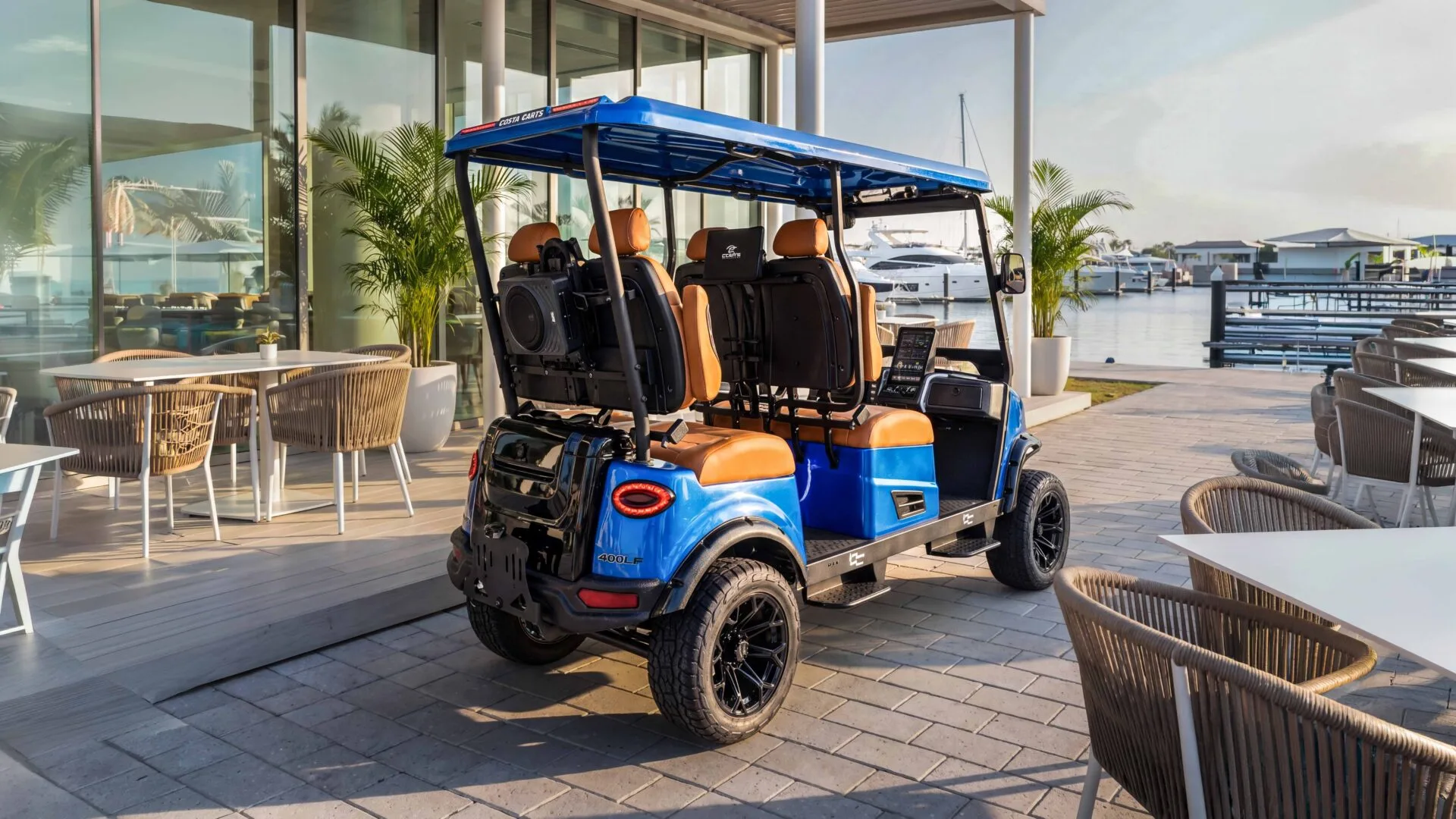
A quality street-legal electric golf cart carries a higher purchase price than a comparable gas model. That’s true and worth acknowledging plainly. The 2026 Costa Carts 400LF and 600L are premium products — engineered as complete systems with a 64V 230Ah lithium battery, 4-wheel independent suspension, hydraulic disc brakes, silent electronic power steering, and a feature set that includes dual 13-inch displays, Apple CarPlay and Android Auto, a premium amplified audio system with a 10-inch subwoofer, backup camera, and a full suite of 2026 upgrades. That level of engineering and finish costs what it costs.
But the upfront price is a one-time event. What happens after purchase is where the total cost of ownership actually gets determined, and that’s where electric — lithium electric specifically — begins to accumulate a structural advantage that compounds over time.
Fuel vs. Electricity: A Cost Difference That Never Stops Adding Up
A gas golf cart runs on gasoline. The cost of that fuel varies with the market, tends to trend upward over time, and shows up every time you use the cart. For a cart covering typical daily community mileage — call it 10 to 15 miles per day of regular use — the fuel cost adds up quietly but consistently across weeks, months, and years.
An electric cart charges at home on standard household current. The cost per mile of electric operation is a fraction of the equivalent gasoline cost. Precise figures depend on local electricity rates and driving patterns, but the operating cost advantage of electric over gas in daily use is consistent and meaningful regardless of where you live in Florida. Over five years of regular ownership, the fuel savings alone frequently offset a significant portion of the upfront price premium for an electric model.
This is the part of the cost conversation that gas-cart buyers often underweight, because the per-fill cost of a gas cart is easy to absorb in the moment. The aggregated cost over five years is less visible — but it’s there, and it’s real.
Maintenance: Where the Structural Difference Is Largest
A gas engine requires regular attention. Oil changes, air filter replacements, spark plug service, fuel system maintenance, belt inspections, carburetor upkeep — each of these is a modest individual cost, but together they represent an ongoing financial and time commitment that electric drivetrain owners simply don’t have. In Florida’s heat and humidity, where sitting fuel degrades faster and mechanical systems are exposed to a more corrosive environment than in drier climates, the maintenance burden on a gas cart is higher than it would be elsewhere.
An electric cart with a lithium battery system has no oil to change, no fuel system to service, no spark plugs to replace, and a drivetrain with far fewer moving parts exposed to the environment. The maintenance a quality electric cart actually needs is minimal — tire rotations, brake inspections, keeping the battery management system healthy, and periodic checks on connectors and contacts. The 2026 Costa models include an active battery balancer standard on both the 400LF and 600L, which keeps cells balanced across the pack and protects long-term battery health without requiring owner intervention.
The practical consequence is that electric cart owners spend less time scheduling service and less money paying for it. Over a five-year ownership period, the maintenance cost differential between a well-built electric cart and a gas equivalent is substantial enough to meaningfully shift the total cost comparison.
Battery Longevity and the Lithium Advantage
The battery is the component most buyers worry about when evaluating electric cart ownership, and it’s worth addressing honestly rather than glossing over.
Lead-acid battery systems, which powered most golf carts until relatively recently, had a legitimate longevity problem. They degraded meaningfully over 4 to 6 years of regular use, replacement was expensive, and the performance decline was gradual enough that owners sometimes didn’t recognize how much range they’d lost until it was significant.
Lithium iron phosphate chemistry, which is the benchmark for quality electric cart applications, is a different story. Lithium packs are rated for thousands of charge cycles — a cycle count that translates to years, often a decade or more, of regular daily use before capacity degrades meaningfully. The Costa 2026 lineup’s active battery balancer extends this further by maintaining cell balance across the pack, preventing the uneven degradation that can shorten battery life prematurely.
A battery replacement that a gas cart owner will never need to think about — because gas carts don’t have traction batteries — is a cost that a lithium electric cart owner, if they’re buying a quality product and maintaining it properly, may never encounter within a reasonable ownership horizon. The battery anxiety that made earlier electric cart ownership a legitimate concern has largely been engineered away in current lithium systems.
Depreciation and Resale Value
Vehicles depreciate. Golf carts are no exception. But the rate and pattern of depreciation varies significantly between categories, and a few dynamics are worth understanding before making a purchase decision.
Premium electric carts with lithium battery systems hold their value better in Florida’s used market than gas equivalents, for a simple reason: the things that buyers in the secondary market care about most — battery condition, remaining range, drivetrain reliability — are where lithium electric carts have a structural advantage. A well-maintained 5-year-old lithium cart with documented service history and a healthy battery is an attractive used purchase. A 5-year-old gas cart with accumulated maintenance history and the mechanical uncertainty that comes with age is a less clean proposition.
The brand matters in this calculation too. Costa Carts is a premium product with growing recognition in the coastal Florida market. As the brand establishes its presence across dealer networks from Deerfield Beach north through the Space Coast and across to the Gulf, that recognition translates into stronger resale demand for used inventory — a factor that benefits owners when it comes time to sell or trade.
What the Five-Year Picture Actually Looks Like
Running an honest five-year cost model requires being specific about assumptions, and those assumptions will vary by individual usage patterns, local electricity and fuel rates, and what maintenance the specific carts actually require. But the structure of the comparison is consistent enough to be useful as a framework.
The electric cart starts with a higher purchase price. That premium gets offset progressively by lower fuel costs, lower maintenance costs, and — with a quality lithium system — no battery replacement expense within the five-year window. By year three of typical ownership, the cumulative operating cost of the electric cart has usually closed most of the upfront price gap. By year five, the electric cart has frequently cost less in total than the gas alternative would have, even accounting for the higher initial outlay.
This is before factoring in the ownership experience itself — the quieter, smoother, more refined driving experience that comes with electric, the freedom from service appointments, the simplicity of plugging in at home rather than making fuel stops. Those aren’t financial line items, but they’re real quality-of-life factors that experienced cart owners consistently cite as reasons they wouldn’t go back to gas.
The Costa Carts 400LF and 600L are built for buyers who are thinking about the full picture — not just what the cart costs to buy, but what it costs to own, what it feels like to live with, and what it represents as an investment in how they want to spend their time. That framing changes the comparison. And once you’ve run the real numbers, it usually makes the decision straightforward.
Frequently Asked Questions
Is an electric golf cart cheaper to own than a gas cart?
Over a full ownership period of five or more years, electric carts — particularly lithium-powered models — typically cost less in total than gas alternatives, despite higher upfront purchase prices. Lower fuel costs, minimal maintenance, and strong battery longevity drive the long-term advantage.
How long do lithium golf cart batteries last?
Quality lithium iron phosphate battery systems are rated for thousands of charge cycles, typically translating to ten or more years of regular daily use before significant capacity loss. This is substantially longer than lead-acid battery systems, which typically require replacement every 4 to 6 years.
What maintenance does an electric golf cart require?
Electric carts require far less maintenance than gas models — no oil changes, no fuel system service, no spark plugs. Regular maintenance typically includes tire rotations, brake inspections, and periodic electrical system checks.
How much does it cost to charge an electric golf cart?
Charging costs depend on local electricity rates and battery size. For a 64V 230Ah system like Costa’s, a full charge from empty costs a fraction of the equivalent gasoline cost, and most owners charge partially — topping off daily rather than running the pack to empty.
Do electric golf carts hold their value?
Premium lithium electric carts in good condition hold their value well in Florida’s active used market. Buyers in the secondary market prioritize battery health and drivetrain reliability — areas where quality lithium carts have a clear structural advantage over gas alternatives.
What is the cost of ownership for a Costa Carts 400LF?
The 400LF’s total ownership cost includes the purchase price, minimal electricity charging costs, low maintenance requirements, and no traction battery replacement expense within a typical ownership horizon. Over five years, the total cost of ownership is highly competitive with — and often lower than — less expensive gas cart alternatives.