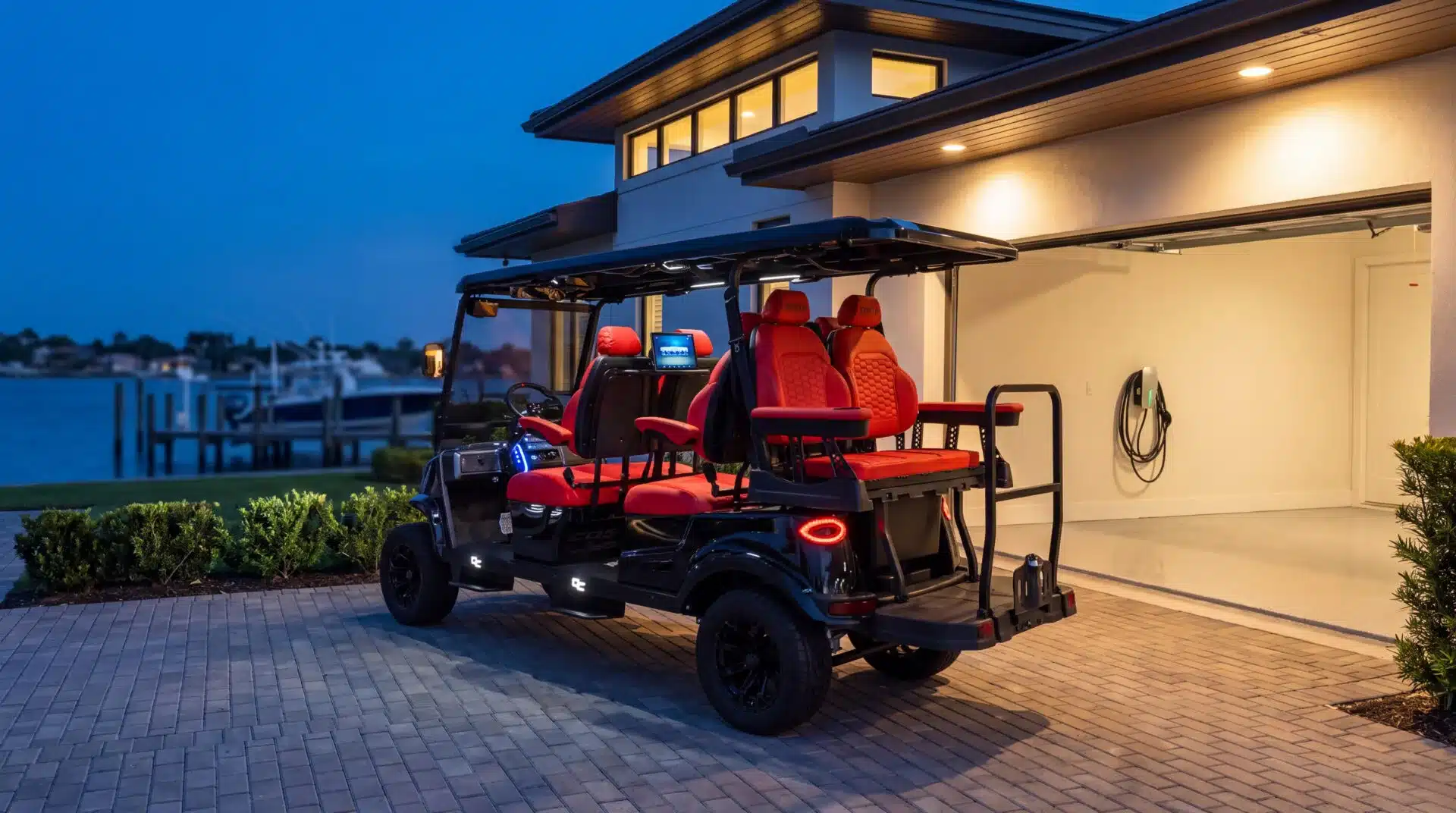
How to Charge an Electric Golf Cart at Home (Time, Cost & Setup)
Most electric golf carts charge fully in 4 to 8 hours from a standard household outlet, and a partial top-up after a normal day of driving usually takes 2 to 4 hours. Lithium packs charge faster than older lead-acid packs and hold a steadier rate through the cycle. Your exact time depends on pack size, charger output and how far you drew the battery down.
How long does it take to charge an electric golf cart?
Charge time is a function of three things: how much energy the pack holds, how much you used, and how fast the charger can put it back. A cart that came home at 60 percent needs far less time than one you ran to 15 percent.
Here are realistic windows for a modern lithium cart on a standard outlet:
- Short errand, 80 to 90 percent remaining: roughly 1 hour
- Typical day around a community, 50 to 60 percent remaining: roughly 3 to 4 hours
- Heavy use, 15 to 20 percent remaining: roughly 6 to 8 hours
Older lead-acid carts sit at the long end of that range and often need 8 to 10 hours, because the final stage of a lead-acid charge is deliberately slow. That difference matters most if you use the cart twice in one day.
Can you charge a golf cart in a regular outlet?
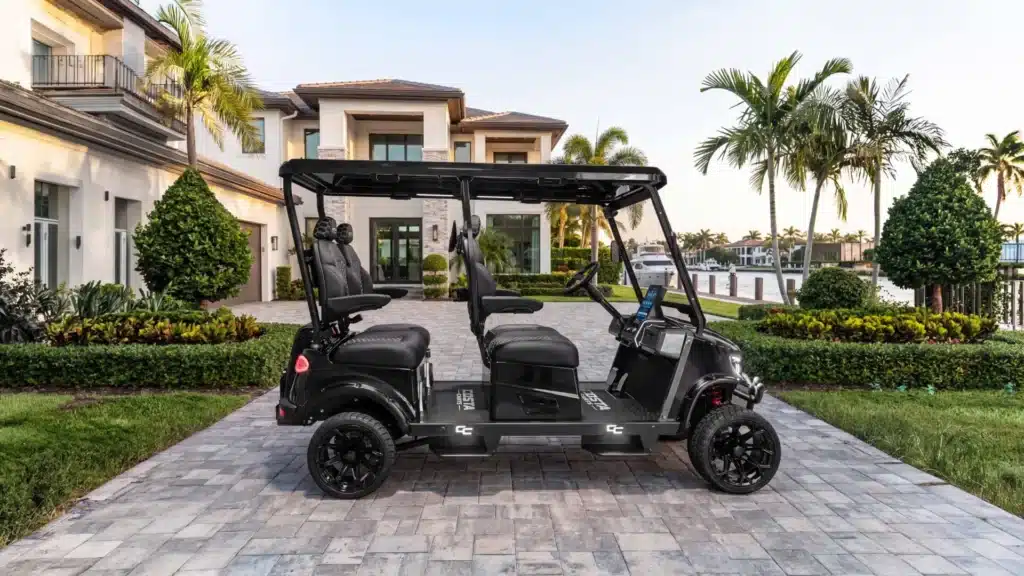
Yes. A standard 120-volt household outlet is the normal way to charge an electric golf cart at home, and it is what most owners use every night. The Costa 64V / 230Ah pack charges from a standard outlet, so no special installation is required to start using the cart the day it arrives.
What the outlet does need is a dedicated circuit and sound wiring. Charging draws steady current for hours at a time, which is different from the short bursts a household outlet usually sees.
What to check before you plug in the first time
- Use a grounded outlet on a circuit that is not shared with a refrigerator, freezer, well pump or shop tools.
- Plug the charger directly into the wall. Skip extension cords, and never use a light-duty household cord.
- Confirm the outlet is rated for continuous load. If the breaker has ever tripped on that circuit, have an electrician look at it first.
- Keep the charger off the floor in any space that can take on water, and keep air moving around it.
If you park in a garage that already serves an EV, a workshop or a pool system, ask your electrician to confirm the panel has headroom before you add a nightly load.
Level 1 vs Level 2 golf cart charging
Level 1 means 120 volts, the outlet you already have. Level 2 means 240 volts, the circuit a clothes dryer or a car EV charger uses. Level 1 is sufficient for nearly every golf cart owner, and that is the honest answer most charging articles avoid.
The reason is simple. A golf cart pack is a fraction of the size of a passenger EV pack, so an overnight window on 120 volts is more than enough to return a full charge. Level 2 only becomes interesting in specific cases.
- Multiple carts sharing one garage or one cart barn
- Two-shift use, such as a resort or club that runs a cart morning and evening
- Fleet operations where turnaround time is the constraint, not convenience
Before you install a 240-volt circuit, confirm with your dealer that your charger supports it. A charger built for 120 volts will not run faster on a bigger circuit, and mismatched equipment is the fastest way to shorten a pack’s life.
How much does it cost to charge a golf cart?
The method is straightforward, and it is more useful than a single number that will not match your utility bill.
- Find the charger’s power draw in watts, listed on the charger label or in your owner documentation.
- Multiply watts by hours charging, then divide by 1,000. That gives you kilowatt-hours.
- Multiply kilowatt-hours by your electricity rate. The U.S. residential average sits near 17 cents per kilowatt-hour, and coastal Florida, California and the Northeast typically run higher.
Run the arithmetic and you will land in the range of pocket change per charge for most households. We deliberately do not publish a fixed per-charge figure, because it depends on your specific charger draw and your local rate. Your Costa dealer can run the exact math against your charger label and your utility’s current rate.
Should you leave a golf cart plugged in?
With a modern lithium pack and its matched charger, yes. The charger stops delivering current when the pack is full and holds it there, so overnight golf cart charging is the simplest habit you can build. Plug in when you park, unplug when you leave.
Two situations call for more care. If you are storing the cart for a season, most lithium packs prefer to sit at a partial state of charge rather than at 100 percent, so ask your dealer what level suits your storage window. And if you own an older lead-acid cart, leaving it connected to an unregulated charger for weeks can boil off electrolyte.
What the app changes
On a Costa 400LF or 600L, the mobile app shows charge state, so you are not guessing from a dash light or walking out to the garage at midnight. You can see where the pack sits before you decide whether tonight’s charge is a top-up or a full cycle.
Underneath that, an active battery balancer manages cell health while charging. It keeps individual cells in step with each other instead of letting one weak cell define the pack’s usable capacity. That work happens quietly, every time you plug in, without anything for you to configure.
Lithium golf cart charging habits worth keeping
Charging behavior is one of the few things fully in your control as an owner. These habits cost you nothing and protect the pack over years of use.
- Charge after use, not before. Plugging in when you park means the cart is always ready and the pack rarely sits deeply discharged.
- Skip the deep discharge. Running to empty as a matter of routine is harder on a pack than frequent partial charges.
- Use the charger that came with the cart. Charger and battery management system are engineered as a pair.
- Let the pack settle in heat. After a long run on a hot afternoon, give the cart 20 to 30 minutes in the shade before you plug in.
- Keep contacts clean and dry. Salt air in coastal communities is hard on connectors. A visual check each month takes seconds.
For setup guidance, app walkthroughs and service scheduling specific to your cart, start with the Costa owners resources.
Charging at a club, resort or gated community
If you keep a cart at a club or in a shared cart barn, charging becomes a facilities question as much as an owner question. Ask three things before you assume a spot is workable.
- Are the outlets on dedicated circuits, or is one circuit feeding a row of chargers?
- Is the charging area covered and ventilated?
- Does the HOA or club have a written policy on overnight charging and cord management?
Developers and HOAs planning new cart storage should size circuits for one charger per bay from the start. Retrofitting a cart barn is far more disruptive than specifying it correctly during construction.
A note on driving where you charge
Charging at home is universal. Driving on public roads is not. Whether your cart can be operated legally on a given street depends on local LSV law, which varies by state, county and municipality, so confirm the rules for your community with your dealer before you plan your routes.
The short version
Plug into a grounded, dedicated 120-volt outlet when you park. Expect a full charge in 4 to 8 hours and a top-up in 2 to 4. Skip Level 2 unless you run multiple carts or two shifts a day. Calculate cost from your charger’s wattage and your utility rate rather than a number from a forum. Then let the app and the balancer do the rest.
Recent Posts
How to Store a Golf Cart for the Off-Season (Snowbird Guide)

Smooth Ride Luxury Electric Golf Cart Engineering: Why Independent Suspension Transforms Resort Trails and Cobblestone Estates
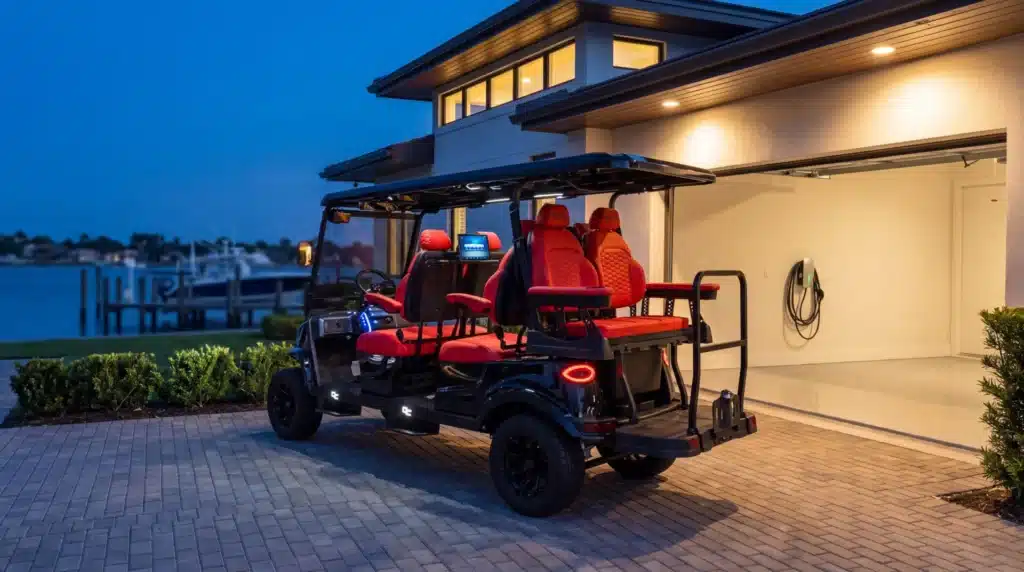
How to Charge an Electric Golf Cart at Home (Time, Cost & Setup)
Electric Golf Cart Maintenance: The Complete Owner’s Guide
Luxury Golf Cart Brands: How the Premium Market Is Actually Stratified