What Is a Street-Legal Electric Golf Cart (LSV) and How Do Costa Carts Qualify?
What Is a Street-Legal Electric Golf Cart?
A street-legal electric golf cart, commonly referred to as a Low-Speed Vehicle (LSV), is an electric vehicle designed to operate legally on public roads with posted speed limits of 35 mph or less.
Unlike traditional golf carts that are restricted to private property or golf courses, an LSV is built to meet federal and state safety requirements, allowing it to be registered, insured, and driven legally in many communities.
For coastal towns, gated neighborhoods, resorts, and planned communities, street-legal electric golf carts offer a practical and eco-friendly alternative to full-size vehicles.
What Qualifies a Golf Cart as an LSV?
To be classified as a street-legal Low-Speed Vehicle, an electric golf cart must meet specific safety and performance standards.
At a minimum, an LSV must include:
- Headlights and taillights
- Brake lights and turn signals
- Windshield meeting safety standards
- Rearview and side mirrors
- Seat belts for all passengers
- Vehicle Identification Number (VIN)
- Maximum speed capability of 20–25 mph
These requirements are governed at the federal level and enforced locally by state and municipal regulations.
Street-Legal Golf Cart Laws in Florida
Florida is one of the most LSV-friendly states in the country, making it an ideal market for street-legal electric golf carts.
In Florida:
- LSVs may operate on roads with posted speed limits of 35 mph or less
- Vehicles must be registered and insured
- Drivers must possess a valid driver’s license
- Local municipalities may impose additional rules based on zoning or community design
Because laws can vary by city or county, choosing a manufacturer that builds carts specifically engineered for compliance is critical.
How Costa Carts Meet Street-Legal Requirements
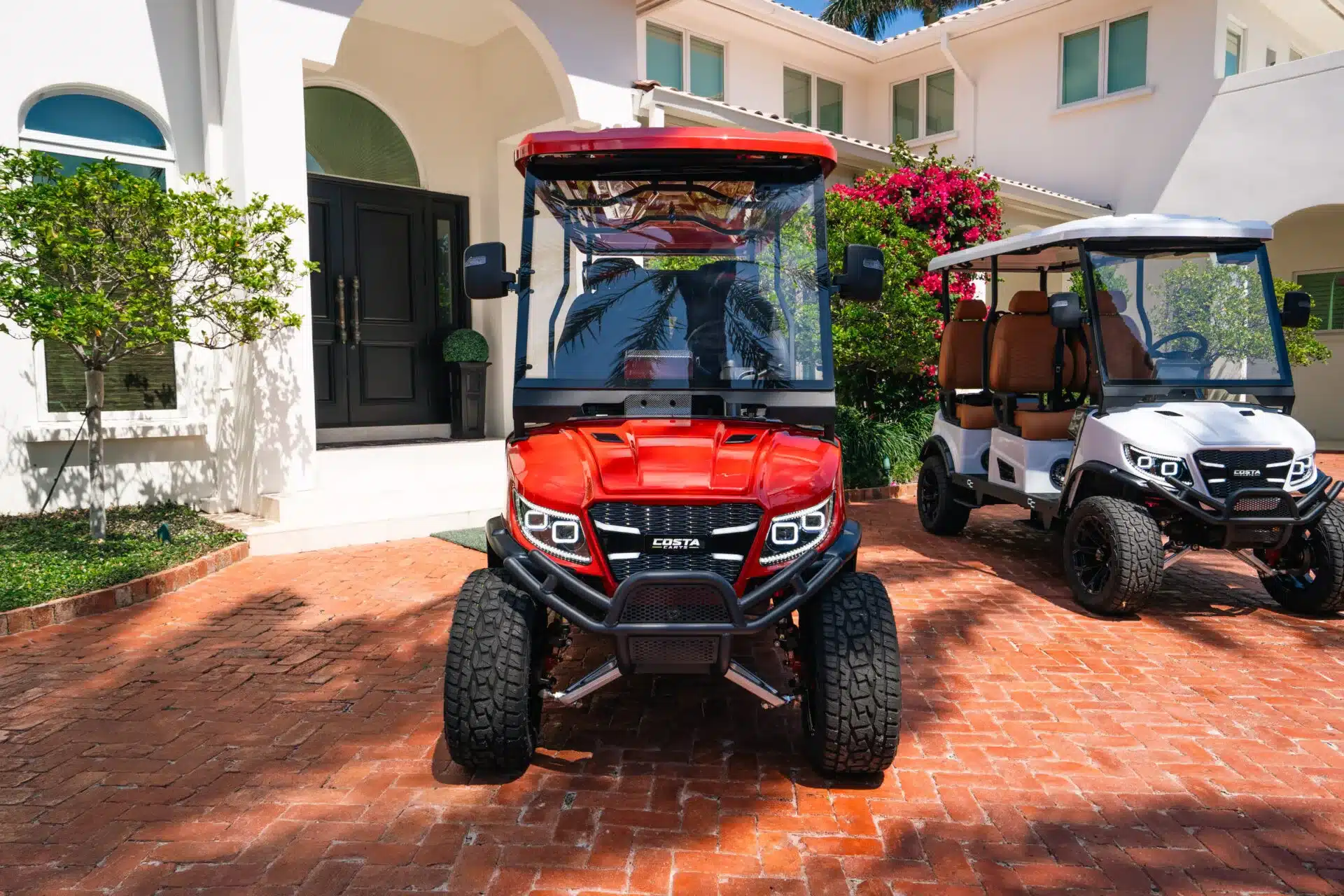
Costa Carts are engineered from the ground up to qualify as street-legal electric golf carts, not retrofitted after the fact.
Each Costa Cart includes:
- Factory-installed safety lighting systems
- DOT-approved windshields and mirrors
- Integrated seat belts
- VIN-ready compliance for registration
- Performance-grade electric drivetrains capable of sustained road use
This approach ensures buyers are not navigating compliance alone or relying on aftermarket modifications to meet legal standards.
LSV vs Traditional Golf Cart: What’s the Difference?
The primary difference between a traditional golf cart and an LSV is intent and construction.
Traditional golf carts:
- Designed for short, private use
- Often lack required safety features
- Not intended for public roads
Street-legal LSV golf carts:
- Built for neighborhood and road use
- Meet safety and visibility standards
- Can be registered and insured
- Offer higher performance and durability
For buyers planning to drive beyond golf courses or private property, an LSV is the only legitimate option.
Why Street-Legal Electric Golf Carts Are Growing in Popularity
Street-legal electric golf carts have become increasingly popular due to:
- Rising fuel costs
- Community-centric living
- Eco-conscious transportation trends
- Short-distance commuting needs
In places like South Florida, they are now commonly used for:
- Neighborhood commuting
- Resort transportation
- Beach-area travel
- Local errands and social outings
Is a Street-Legal Golf Cart Right for You?
If you live in a community where most daily trips are short and roads are low-speed, a street-legal electric golf cart can offer convenience, efficiency, and lifestyle appeal that traditional vehicles cannot.
Understanding what qualifies a cart as street-legal is the first step toward making a confident buying decision. Contact Costa Carts Today
FAQs from Costa Carts
Q1: What is the difference between a traditional golf cart and a street-legal Low-Speed Vehicle (LSV)?
A1: The primary difference is engineering certification, road legality, and safety equipment. While standard golf carts are limited to 15–19 mph on private golf courses, street-legal LSVs meet federal FMVSS 500 standards with 20–25 mph top speeds, factory 17-digit VINs, automotive safety glass, and 3-point seat belts. Every Costa Cart is purpose-built as an authentic LSV, allowing legal registration for public roadways.
Q2: Are Costa Carts street-legal on public roads in Florida and other coastal states?
A2: Yes, Costa Carts are fully street-legal Low-Speed Vehicles certified to operate on public roads with posted speed limits of 35 mph or less. Under Florida law and federal statutes, LSVs require registered license plates, valid insurance,and a licensed driver. Our vehicles arrive VIN-compliant from our Deerfield Beach facility with full lighting, DOT mirrors, and hydraulic disc brakes for immediate DMV titling.
Q3: How far can a Costa Cart travel on a single battery charge?
A3: Costa Carts deliver up to 100 miles of real-world driving range on a single charge thanks to high-capacity 64V/72V lithium architectures. Unlike legacy 48V carts that experience severe voltage sag, our high-voltage battery management systems draw lower amperage, preventing excessive heat and preserving energy density. This allows coastal estate owners and resort guests all-day neighborhood cruising without mid-day charging anxiety.
Q4: How do Costa Carts prevent frame rust and corrosion in coastal, saltwater environments?
A4: Costa Carts feature black powder-coated, marine-grade aluminum chassis that provide complete immunity against salt-air oxidation and moisture degradation. Traditional steel-frame golf carts rust and fail quickly in coastal climates.Our aluminum metallurgy naturally forms an anti-corrosive passivation layer, which we seal with electrostatically cured powder coating to guarantee ten-plus years of structural integrity across oceanfront estates and island resorts.
Q5: Which Costa Cart model is best suited for my family or resort property?
A5: Model selection depends on your passenger capacity and property application. The 400LF Series is our agile 4-passenger flagship, ideal for everyday neighborhood commuting, coastal running, and private golf communities. For larger families, waterfront estates, or hospitality shuttles, the extended 600L and 600S Series deliver 6-passenger extended layouts, commanding curb appeal, and expanded luxury storage.
Q6: How long does it take to charge a Costa Cart, and what type of outlet is required?
A6: A Costa Cart charges from empty to full in approximately 5 to 7 hours using a standard 110V household exterior outlet. The smart on-board high-frequency charger plugs directly into standard residential receptacles, eliminating the need for expensive commercial charging stations. Opportunity charging during lunch or between resort outings easily restores 20 to 30 miles of range in just two hours.
Q7: What in-cabin technology and infotainment systems are included in Costa Carts?
A7: Every luxury Costa Cart features dual 13-inch digital cockpit displays equipped with wireless Apple CarPlay,Android Auto, and high-definition backup cameras. Drivers enjoy integrated satellite navigation, hands-free calling,real-time battery analytics, and a marine-grade sound system paired with an amplified 10-inch subwoofer. A weatherproof push-to-start ignition and wireless phone charging pads complete the connected automotive-grade experience.
Q8: What makes the ride quality and handling of a Costa Cart superior to standard golf carts?
A8: Costa Carts utilize automotive-grade independent 4-wheel suspension with a 2.5-inch factory lift and silent Electronic Power Steering (EPS). Standard golf carts rely on rigid rear leaf-spring axles that create harsh, bouncy rides.Our autonomous control arms and coil-over shock dampers absorb uneven curbs and terrain, while 4-wheel hydraulic disc brakes provide smooth, immediate stopping power.
Q9: What routine maintenance is required for a Costa Cart electric LSV?
A9: Maintenance is minimal because the direct-drive electric powertrain has no engine oil, spark plugs, belts, or transmission fluid. Routine care consists of simple monthly owner walkarounds: checking tire pressures, wiping down brake rotors, and rinsing off exterior salt air spray with clean water. The sealed lithium battery requires zero watering, while smart mobile app diagnostics monitor system performance in real time.
Q10: How do I purchase, title, and register a Costa Cart for legal street driving?
A10: You can configure your vehicle directly through Costa Carts or connect with our authorized dealer network for private delivery. Because each vehicle is manufactured with an official 17-digit VIN and Manufacturer Certificate of Origin (MCO), titling and registering with your state DMV or tax collector is seamless. Contact our Deerfield Beach team at (954) 569-5384 to schedule a private test drive.
Recent Posts

Sequential LED Signals & LSV Nighttime Visibility
Resort Electric Cart Fleet Management ROI Guide
Quiet Electric Cart Nature Trail Driving: Costa Carts LSV Guide
Powder Coated Aluminum Chassis Golf Carts: The Rust-Free Standard

Luxury Island Resort Electric Cart: The 64V LSV Guide