How Long Do Electric Golf Carts Last? A Whole-Vehicle Lifespan Guide
Fast Track Summary
- Realistic Lifespan Range: A well-built electric LSV commonly serves for many years and often more than a decade, and the deciding factor is the chassis and drivetrain, not the battery alone.
- The Whole-Vehicle View: Batteries, tires and controllers are replaceable. A corroded frame, a worn drivetrain mount or a failing brake system is what actually ends a cart’s service life.
- Corrosion Is the Clock: In coastal and irrigated environments, salt and moisture attack the frame first. A black powder-coated aluminum chassis resists that chain in a way a bare steel frame does not.
- Engineering as Systems: Costa Carts builds the 400LF and 600L around an EV-grade 64V drivetrain and 4-wheel hydraulic disc brakes engineered as complete systems rather than assemblies of sourced parts.
- When to Replace: Replace when frame integrity, brake geometry or drivetrain mounting is compromised. Keep and maintain when only consumables and the battery are due.
A property manager at a gated club community in Palm Beach County keeps two carts side by side in the maintenance barn. Both were bought the same spring. One still tracks straight, closes its doors cleanly and stops without drama. The other sits with a soft rear suspension, a frame that has begun to bubble under the paint near the rear crossmember, and a brake pedal that travels too far before it does anything.
Neither cart failed because of its battery. Both got new batteries at roughly the same point. The difference was everything the battery was bolted to. That is the question this article answers: how long do electric golf carts last as complete vehicles, what actually wears out first, and how to tell whether the cart in front of you has years left or is done.
If you are shopping, comparing or deciding whether to keep what you own, the useful framing is not years on a spec sheet. It is which components are consumable, which are structural, and how the two interact over time.
How long do electric golf carts last?
Section Overview:
An electric golf cart or LSV is a low-speed electric vehicle whose service life is set by its chassis, drivetrain and braking system, not by its battery. Batteries, tires, bushings and brake pads are replaceable consumables. A well-engineered cart commonly serves for many years and frequently beyond a decade, while a lightly built cart in a coastal setting can lose structural integrity far sooner.
The honest answer is a range, and the range is wide because the vehicles are not comparable. Two carts with the same battery chemistry and similar motors can be separated by a decade of useful life depending on frame material, coating, brake design and how the drivetrain is mounted.
Most published lifespan figures actually describe battery life and then imply the vehicle ends when the pack does. That is backwards. A battery is a scheduled replacement. A frame is not.
Consumable versus structural
Sorting components into these two buckets is the fastest way to judge a cart’s remaining life. Consumables are budgeted. Structural failures are terminal.
- Consumable Components: Battery pack, tires, brake pads and rotors, bushings, wiper blades, upholstery and trim. All are designed to be serviced and replaced on a schedule.
- Semi-Structural Components: Suspension arms, steering linkage, motor and controller mounts. Replaceable, but replacement cost and labor rise sharply as they age together.
- Structural Components: Chassis, subframe, mounting points and body substructure. When these degrade, the vehicle is finished regardless of what else is new.
- Systems Integration: The way those three groups are engineered to work together. This is the invisible variable that separates a cart that ages gracefully from one that unravels.
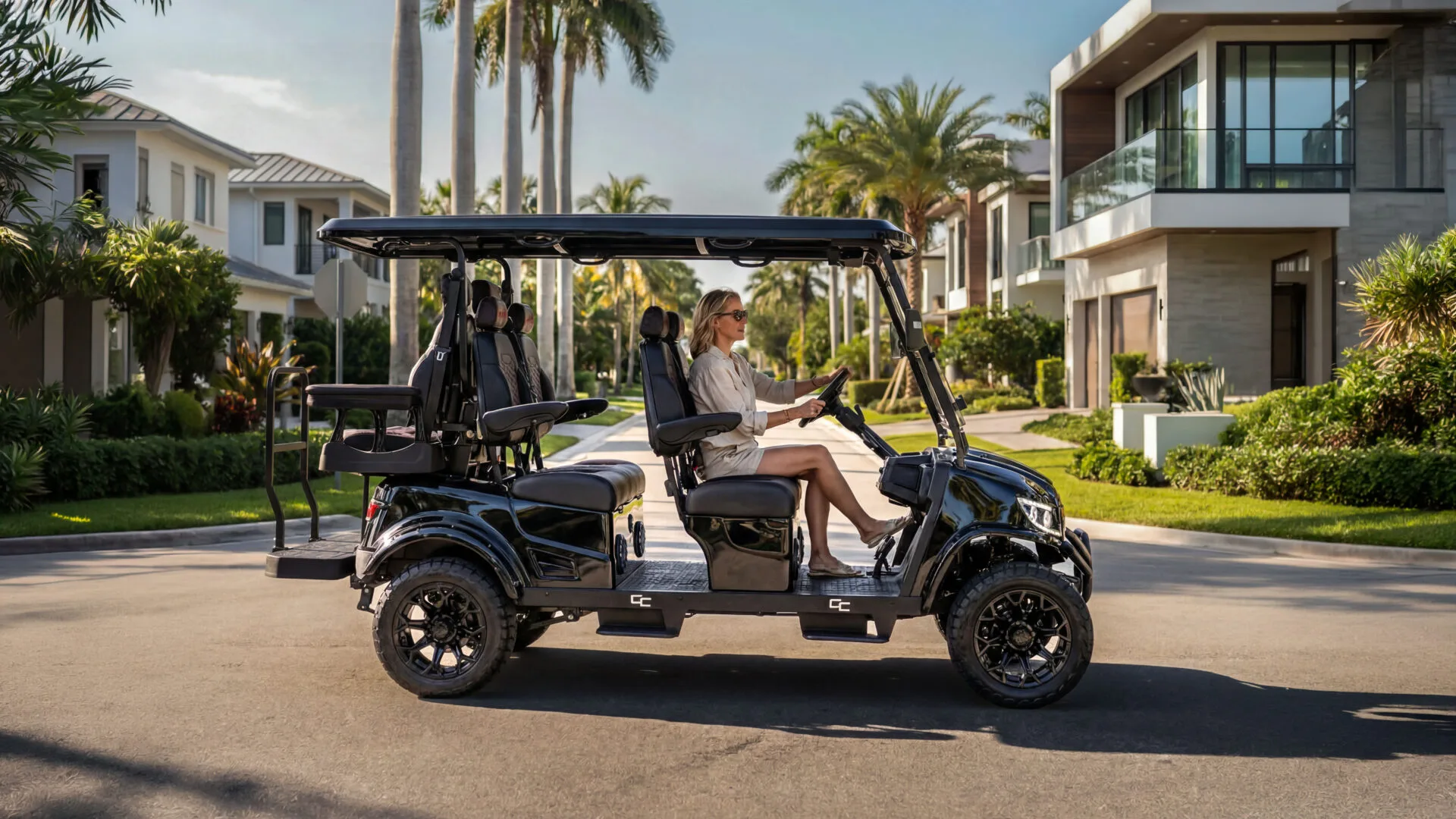
You can see this logic in how Costa specifies the 400LF Series and the 600L Series. The chassis, drivetrain and brakes are treated as one engineered package, so the consumables can be replaced repeatedly without the surrounding structure becoming the limiting factor.
Do electric golf carts last longer than gas models?
Section Overview:
Electric golf carts generally last longer than gas models because an electric drivetrain has far fewer moving and wearing parts. There is no combustion engine, no oil system, no exhaust and no fuel system to degrade. Electric carts trade those maintenance items for a battery pack on a replacement schedule, which shifts the lifespan question from the powertrain to the chassis and brakes.
The comparison is less about durability and more about failure modes. A gas cart accumulates wear across dozens of interacting mechanical parts. An electric cart concentrates its wear into a much smaller set.
Where each one wears out
- Gas Powertrain: Engine internals, oil, spark, belts, fuel lines and exhaust all age simultaneously and each one can strand the vehicle independently.
- Electric Powertrain: A sealed motor, a controller and a battery pack. The motor and controller are long-lived, and the pack is a planned replacement rather than a failure.
- Vibration Load: A combustion engine transmits constant vibration into mounts, fasteners and trim. An electric drivetrain runs smoother, so mechanical connections stay tight longer.
- Braking Duty: Both platforms depend entirely on the brake system for controlled stops. Design quality here matters more than fuel type.
That is why the interesting question for an electric buyer moves upstream. Once the powertrain stops being the weak link, the frame, the corrosion protection and the brakes become the whole conversation.
What actually ends a golf cart’s life?
Section Overview:
Corrosion of the chassis ends more golf carts than any single mechanical failure, particularly in coastal, salt-air and irrigated environments. The typical sequence begins with a coating breach, progresses to moisture intrusion at fasteners and welds, then to compromised mounting points for suspension, steering and drivetrain. At that stage alignment, brake geometry and ride quality degrade together and repair stops being economical.
Corrosion is not a single event. It is a chain, and each link makes the next one faster. Naming the sequence is the most useful diagnostic tool an owner has.
The corrosion causal chain
- Coating Breach: A stone chip, a curb scrape or a fastener working loose exposes bare metal on the frame or subframe.
- Moisture Intrusion: Salt spray, irrigation overspray and washdown water reach the exposed metal and stay there, held by dirt and trapped in seams.
- Fastener and Weld Attack: Corrosion concentrates at joints, where dissimilar metals meet and where welds create small crevices that hold moisture.
- Mounting Point Degradation: Suspension, steering and drivetrain mounts lose their precise location. Alignment drifts and loads redistribute.
- Cascading Wear: Misaligned suspension chews tires, brake geometry shifts, drivetrain mounts flex under load, and the vehicle begins to wear itself out faster than it can be repaired.
This is precisely the chain a black powder-coated aluminum chassis is designed to interrupt. Aluminum does not rust the way steel does, and a powder-coated finish gives the frame a durable barrier rather than a sprayed-on film. Costa treats that chassis as the foundation of the Costa Experience, because everything else bolts to it.
Brakes and the stopping system
The second common life-ending failure is a braking system that was never designed for the vehicle’s real mass and duty cycle. Drum brakes and mechanical linkages are cheap to build and inconsistent to maintain, especially in humid coastal air where cables seize and drums hold moisture.
4-wheel hydraulic disc brakes change the maintenance picture. Pads and rotors are inspectable and replaceable, hydraulic pressure is distributed evenly, and there is no cable to stretch or corrode. That is the difference between a brake system you service and a brake system you eventually give up on.
Drivetrain longevity
An EV-grade 64V drivetrain matters for lifespan because voltage architecture determines how hard the system has to work to deliver the same output. A drivetrain engineered as a complete system, with the motor, controller and battery specified together, runs within its intended envelope rather than at the edge of it.
Electric motors in this class are among the longest-lived components on the vehicle. What shortens them is heat, water intrusion and poor mounting, all of which are chassis and integration problems rather than motor problems. You can review how the platforms differ across the full model lineup.
How do you extend an electric golf cart’s lifespan?
Section Overview:
Extending an electric golf cart’s lifespan means protecting the chassis, servicing the brake system on schedule and keeping the battery within its intended operating habits. The highest-value habits are rinsing salt and irrigation residue off the underbody, inspecting the frame coating for breaches, checking brake pad and rotor condition, and having suspension and steering fasteners verified by an authorized dealer.
Longevity work is unglamorous and mostly preventive. The ordered sequence below is how a competent service department approaches an LSV that the owner intends to keep for a long time.
The ownership maintenance sequence
- Step One, Underbody Rinse: Rinse the underside after coastal driving or exposure to irrigation overspray. This removes the salt and mineral residue that starts the corrosion chain.
- Step Two, Coating Inspection: Look for chips, scrapes and bubbling on the frame and subframe. Addressing a breach early rules out the moisture intrusion stage entirely.
- Step Three, Brake Check: Inspect pad thickness, rotor surface and pedal feel. Excess pedal travel or uneven wear points to a hydraulic or caliper issue, not a pad issue.
- Step Four, Suspension and Steering: Verify bushings, arms and linkage for play. Any looseness here shows up next as tire wear and alignment drift.
- Step Five, Charging Habits: Charge on the schedule and equipment specified for the pack, and avoid long periods at very low state of charge in storage.
- Step Six, Dealer Service Interval: Bring the vehicle to an authorized dealer for scheduled inspection so torque values, software and wear items are checked together.
Owner resources and service scheduling live in the owners section, and Costa service outlines what an authorized dealer handles. If you need someone nearby, use the dealer locator.
A note on the battery question
Battery life deserves its own treatment and it is genuinely different from vehicle life. Lithium packs behave differently from lead-acid, and the metrics involved are cycle-based rather than calendar-based. Keep the two questions separate when you evaluate any cart, and remember that a new pack in a corroded chassis buys you very little.
Real-World Scenarios
Oceanfront Condominium Association, Deerfield Beach
- Environment: Direct salt air, sand intrusion, daily short trips between tower entrances and the beach access ramp.
- Primary Wear Driver: Chassis and fastener corrosion, accelerated by salt residue that is never fully rinsed off the underbody.
- What Fails First: Frame coating at scrape points, followed by brake hardware and suspension fasteners near the rear axle.
- Lifespan Lever: An aluminum chassis with a powder-coated finish plus a disciplined rinse and inspection routine after beach-side use.
Master-Planned Golf Community, Naples
- Environment: Heavy irrigation overspray, long paved runs between the clubhouse and outlying villages, frequent stop-and-go at gates.
- Primary Wear Driver: Brake duty cycle combined with mineral-laden water sitting on brake hardware and frame seams overnight.
- What Fails First: Brake components on carts with cable-actuated or drum systems, then tires as alignment drifts.
- Lifespan Lever: Four-wheel hydraulic disc brakes that can be inspected and serviced rather than replaced as a seized assembly.
Private Island Resort Fleet, Florida Keys
- Environment: High daily utilization by many drivers, constant salt exposure, curbs and loading zones that scrape frames and rockers.
- Primary Wear Driver: Cumulative impact damage that breaches protective coatings, multiplied by round-the-clock duty.
- What Fails First: Suspension bushings and drivetrain mounts, which then transfer irregular loads into the frame.
- Lifespan Lever: A drivetrain, chassis and brake package engineered as one system, so mounting points hold their geometry under fleet use.
Key Takeaways
- Lifespan Is Structural: How long an electric golf cart lasts is set by the chassis, drivetrain and brakes, because the battery and tires are replaceable consumables.
- Electric Outlasts Gas: Fewer moving parts, no combustion maintenance items and less vibration mean an electric drivetrain stops being the limiting factor early on.
- Corrosion Is the Real Clock: Coating breach leads to moisture intrusion, then fastener and weld attack, then mounting point failure and cascading wear.
- Systems Beat Assemblies: The 400LF and 600L are built around a black powder-coated aluminum chassis, an EV-grade 64V drivetrain and four-wheel hydraulic disc brakes engineered together.
- Replacement Signal: Replace when frame integrity, brake geometry or drivetrain mounting is compromised. Service and keep the vehicle when only consumables are due.
Talk to a Costa Carts Dealer About Long-Term LSV Ownership
If you are weighing whether to keep, replace or upgrade, the most useful next step is a walkthrough of the chassis, brake system and drivetrain with someone who inspects these vehicles every week. An authorized dealer can assess what is consumable on your current cart and what is structural. Street legality always depends on the LSV rules in your specific municipality, county and state, so confirm local requirements before you register.
Reach out through the Costa Carts contact page to be connected with a dealer in your area, or build a specification in the configurator first. You can also call (954) 569-5384.
External References
- Consumer Product Safety Commission: CPSC publishes safety guidance relevant to low-speed and recreational vehicles.
- Florida Highway Safety and Motor Vehicles: FLHSMV covers registration and titling requirements for low-speed vehicles in Florida.
- SAE International: SAE International develops the engineering standards used across vehicle chassis, brake and drivetrain design.
- ENERGY STAR: ENERGY STAR provides background on electrical efficiency and charging equipment considerations.
Recent Posts

Golf Cart Apple CarPlay 13 Inch Display: Complete Guide

Golf Cart Anti-Theft Ignition Safety: Prevent LSV Theft

Florida Street Legal LSV Regulations Guide | Costa Carts

DOT Requirements for Street-Legal Low-Speed Vehicles (LSVs)

Costa Carts 600 vs Yamaha Concierge & Denago Rover XL