From Driveway to Dock: How People Are Using Golf Carts Beyond the Course
When you’re shopping and you see the phrase “street-legal golf cart,” it’s worth knowing that, in the eyes of federal law, there’s technically no such thing. The LSV vs golf cart distinction isn’t a trim level or a marketing label — it’s a legal classification that decides whether a vehicle can be titled, registered, and driven on a public road at all. A golf cart is built for the course. A low-speed vehicle (LSV) is a federally recognized motor vehicle. And an NEV is simply the electric version of that LSV. Getting the categories straight is the single most useful thing you can do before you buy.
Here’s the clean version:
- Golf cart — A vehicle designed primarily for use on a golf course, typically limited to around 15 mph. It is not a federally regulated motor vehicle and, on its own, is not built for public roads.
- LSV (low-speed vehicle) — A federal vehicle class defined under FMVSS 500: a four-wheeled motor vehicle with a top speed of more than 20 mph and not more than 25 mph on a paved level surface, and a gross vehicle weight rating under 3,000 pounds, equipped with road-safety gear from the factory.
- NEV (neighborhood electric vehicle) — The common name for an electric-powered LSV. Same federal class, same requirements — just battery-powered.
What Is an LSV? The Federal Definition That Actually Matters
The low-speed vehicle class isn’t a state invention or an industry buzzword. NHTSA established Federal Motor Vehicle Safety Standard No. 500 in June 1998, defining a low-speed vehicle as a four-wheeled motor vehicle, other than a truck, whose maximum speed is between 20 and 25 miles per hour. That’s the “25 mph vehicle class” you’ll see referenced, and it’s the line that separates a real road vehicle from recreational equipment.
To be sold as an LSV, a vehicle has to arrive with a specific set of road equipment built in. Standard No. 500 requires:
- Headlamps
- Front and rear turn signal lamps
- Tail lamps
- Stop lamps
- Reflex reflectors
- Mirrors
- A parking brake
- A windshield
- A Vehicle Identification Number
- A seat belt at each designated seating position
Electric models carry one more requirement: a pedestrian sound system that conforms to the federal minimum-sound standard for electric vehicles, so people can hear a nearly silent cart approaching. Beyond that list, LSVs are exempt from most of the federal safety standards that apply to motor vehicles and are not required to meet crashworthiness criteria — which is precisely why they’re allowed to stay small, light, and capped at 25 mph.
Here’s the part most buyers miss. The federal government sets the equipment rules, but the states decide where these vehicles can actually go. States, not NHTSA, are responsible for regulating operation on public roads and for LSV titling and registration, and most states allow LSVs to travel on roadways with speed limits of no more than 35 mph. A few don’t allow them on public roads at all — Connecticut, Mississippi, Montana, and Pennsylvania have no statutes permitting LSV use on their roads. So the honest answer to “can I drive it on the street” is always the same: federally it qualifies, but confirm your state and local rules before you count on it.
Is a Golf Cart a Motor Vehicle?
Short answer: no. A true golf cart is designed for the course, generally tops out around 15 mph, and isn’t built or certified to FMVSS 500. It has no motor-vehicle VIN, no required lighting-and-safety package, and no federal road classification. That’s the entire substance of the “golf cart vs low speed vehicle” question — one is recreational equipment, the other is a regulated motor vehicle.
This is also why “street-legal golf cart vs LSV” is something of a trick comparison. When a cart is genuinely legal to drive on public streets, it’s because it meets the LSV standard — at which point it isn’t really a golf cart anymore. It’s a low-speed vehicle that happens to look like one. The body style is familiar; the legal reality underneath is completely different. A golf cart can sometimes be driven on specific local roads by ordinance, often within a short distance of a course, but that’s a narrow local allowance, not the same as being a road-legal vehicle you can register and take through your neighborhood.
NEV vs LSV: Is There Actually a Difference?
For most buyers, no — an NEV is an LSV. “Neighborhood electric vehicle” is the everyday term for an electric-powered low-speed vehicle, and the two get used interchangeably on dealer lots and in state DMV language alike. Federally, the class is “low-speed vehicle”; “NEV” and “electric LSV” describe the same thing with the powertrain called out. The only place the distinction carries any weight is that a handful of states write their own NEV provisions on top of the federal LSV standard, so your local paperwork might use one term or the other. Functionally, if it’s a four-wheeled, 25-mph, road-equipped electric cart, you’re looking at an NEV and an LSV at the same time.
LSV vs Golf Cart: Which One Can You Actually Drive on the Road?
Put the three side by side and the practical picture gets simple. A golf cart belongs on the course and on whatever limited local paths your community specifically permits. An LSV — including its electric NEV form — is a titled, registered, insurable vehicle that most states allow on public roads posted up to 35 mph. That ceiling exists on purpose: a 25-mph vehicle mixing with much heavier, faster traffic is a safety mismatch, which is the reasoning behind keeping low-speed vehicles on slower roads. The takeaway for anyone weighing options is that the badge on the vehicle matters far less than the class it’s certified in. Of these three, only one is a genuine road vehicle nationwide — and it’s the LSV.
Where Costa Fits: Built as a Premium LSV
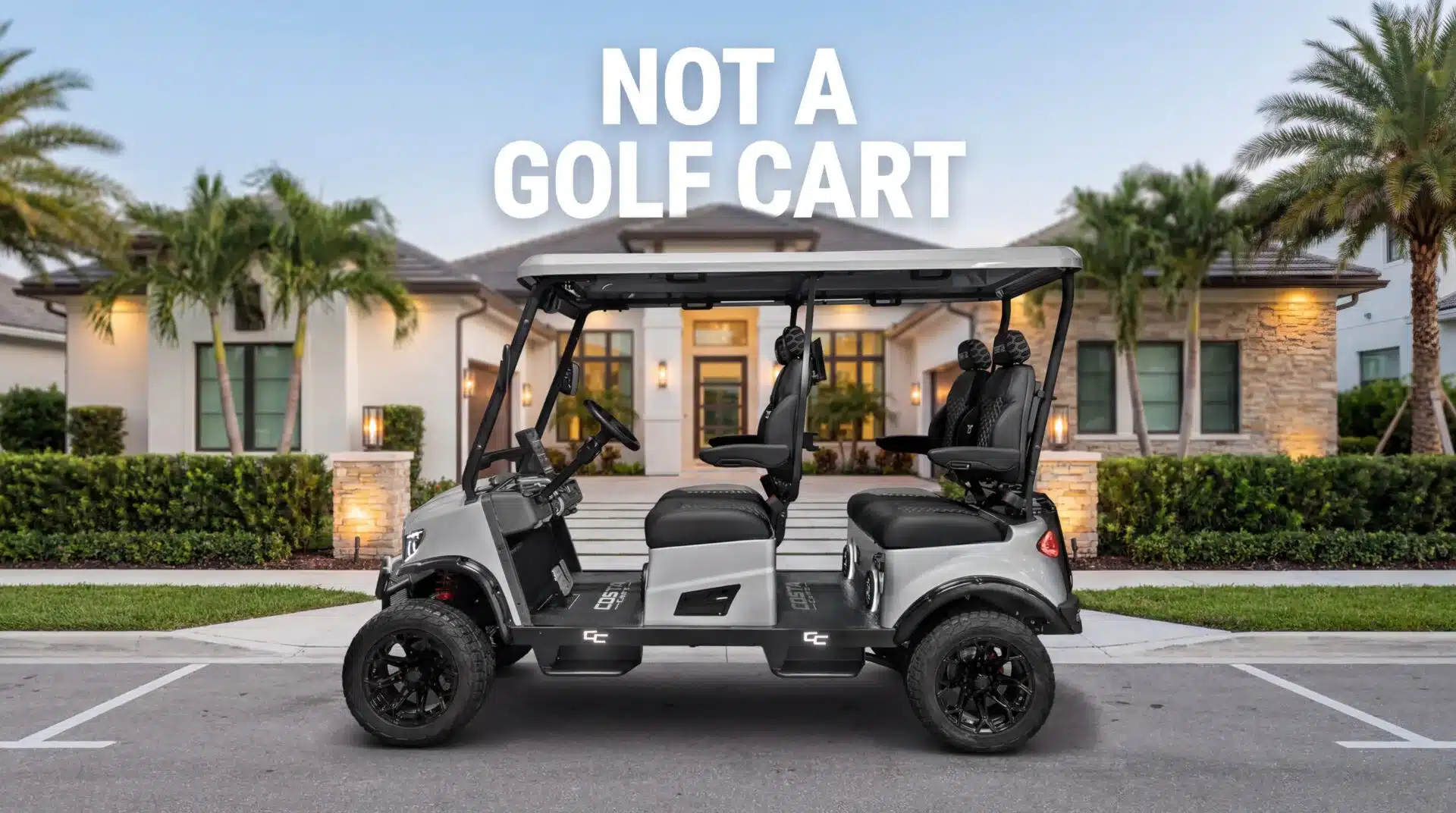
Costa Carts builds in the LSV category, not the golf-cart one. The available 400LF and 600L are engineered as street-legal low-speed vehicles in the 25-mph federal class, which is what lets owners register them and drive them through their communities rather than trailer them to a course. Where Costa separates from the rest of the field is what it puts inside that class:
- A 100-mile range on a 64V power system
- Electronic power steering with a tilt-and-telescopic wheel
- Independent suspension tuned for ride quality
- A 13-inch driver display
It’s the difference between a cart that merely qualifies as an LSV and one that’s been designed — in the brand’s own words — with precision. You can see how the lineup is built on the Costa models page.
People Also Ask
What is the difference between an LSV and a golf cart?
An LSV is a federally recognized motor vehicle class under FMVSS 500 — four wheels, a 20–25 mph top speed, under 3,000 pounds, and factory road-safety equipment — that can be titled, registered, and driven on public roads. A golf cart is course equipment, tops out around 15 mph, and isn’t a federally regulated motor vehicle. In short: an LSV is street-legal by design; a golf cart isn’t.
Is an NEV the same as an LSV?
Essentially, yes. NEV stands for “neighborhood electric vehicle,” the common name for an electric-powered LSV. Same federal class and requirements — the term just specifies that it runs on batteries. Some states add their own NEV rules, but the underlying standard is the federal LSV definition.
Is a golf cart a motor vehicle?
Not under federal law. A standard golf cart isn’t built or certified to FMVSS 500, has no motor-vehicle VIN, and isn’t classified as a road vehicle. It can be driven only where local rules specifically allow, usually near a golf course. If a “golf cart” is truly street-legal, it actually meets the LSV standard.
What does FMVSS 500 require?
FMVSS 500 sets the minimum equipment for a low-speed vehicle: headlamps, front and rear turn signals, tail lamps, stop lamps, reflex reflectors, mirrors, a parking brake, a windshield meeting federal glazing standards, a VIN, and seat belts at every seat. Electric models must also meet the federal pedestrian-sound requirement. LSVs are otherwise exempt from full passenger-car crash standards.
How fast can an LSV go?
By definition, an LSV’s top speed is capped between 20 and 25 mph. That 25-mph limit is what keeps it in the low-speed class and what determines which roads it’s allowed on — most states permit LSVs on streets posted at 35 mph or lower.
The Bottom Line
If you remember one thing from the LSV vs golf cart comparison, make it this: the category is the product. A golf cart and a low-speed vehicle can look nearly identical in a photo and be worlds apart the moment you try to register one and drive it home. Before you buy, confirm the vehicle is a true LSV, and confirm what your state and community allow. Once you know it’s built to the right standard, the only question left is how well it’s built — and that’s where the real decision begins.
Recent Posts

Golf Cart Apple CarPlay 13 Inch Display: Complete Guide

Golf Cart Anti-Theft Ignition Safety: Prevent LSV Theft
Florida Street Legal LSV Regulations Guide | Costa Carts
DOT Requirements for Street-Legal Low-Speed Vehicles (LSVs)

Costa Carts 600 vs Yamaha Concierge & Denago Rover XL