Can You Drive an Electric Golf Cart in the Rain?
Are Golf Carts Waterproof
- Direct Answer: Yes, you can drive an electric golf cart in the rain, provided the vehicle is built with sealed electronics and you avoid standing water, flooded low points and high-pressure spray at the charge port.
- Water-Resistant, Not Waterproof: No street-legal LSV is submersible. The correct term is water-resistant: designed to shed rain and spray from above, not to be driven through a flooded swale or washed with a pressure washer.
- Where Damage Actually Starts: The charge port, the controller housing, exposed ring terminals and any unsealed switch are the first failure points. Salt-laden coastal air accelerates every one of them.
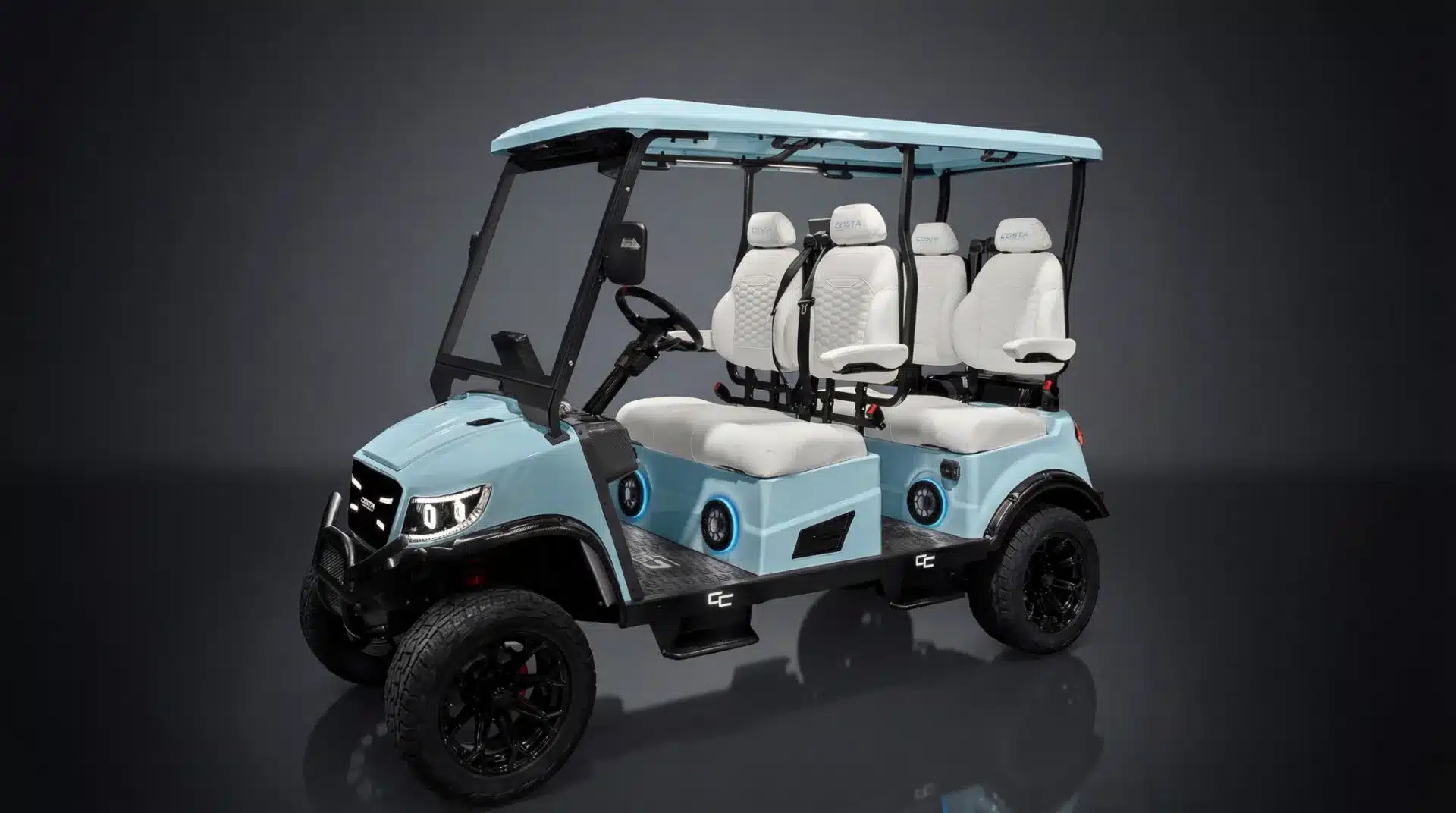
- Costa Hardware Built For It: The 400LF and 600L use a waterproof LED push-to-start with safety shutoff, sealed EV-grade electronics, marine vinyl seats and a DOT acrylic folding windshield, engineered for coastal, wet climates.
- Federal Equipment Context: The Electronic Code of Federal Regulations requires low-speed vehicles to carry a windshield conforming to the federal glazing standard, along with headlamps, turn signals, taillamps, stop lamps, reflectors, mirrors, a parking brake, a conforming VIN and seat belts at each seating position.
An afternoon storm builds over the Intracoastal, the kind that arrives in eleven minutes and leaves in twenty. You are two fairways from the clubhouse in a cart with an open cabin, a phone on the dash and a charge port under the rear seat. The question is not academic at that point. It is whether you drive back or wait it out under the cart barn overhang.
The honest answer is that you drive back, and the cart is fine, as long as it was engineered for that moment and you avoid a small number of specific mistakes. The failures that ruin electric carts are rarely caused by rain falling on them. They are caused by water reaching places rain does not normally reach: a charge port left open, a controller bay sitting in a puddle, a pressure washer aimed at a battery tray.
This article answers two things. First, what actually happens to an electric LSV in wet weather, and where the real risk sits. Second, how to protect a cart that lives in a coastal or subtropical climate, where salt spray does more long-term harm than any single storm.
Can Golf Carts Get Wet Without Damage?
The Short Answer:
A modern electric low-speed vehicle is water-resistant, not waterproof. Rain falling on the body, seats and dash causes no harm when the electronics are sealed and the charge port is closed. Damage begins when water is forced into an enclosure: driving through standing water deeper than the floorboard, pressure washing the battery tray, or charging with a wet port. Costa carts use sealed EV-grade electronics for exactly this reason.
Rain Falling On A Cart Is Not The Threat
Water arriving from above, at atmospheric pressure, is the mildest thing a cart will meet. It runs off the canopy, off the marine vinyl, down the body panels and out through the floor drains. A well-built cart is designed around that path.
The threat changes when water is pushed rather than dropped. A tire hitting a six-inch puddle at speed throws water sideways and upward into the undercarriage. That is a different pressure and a different direction than rain, and it is where sealed housings earn their keep.
The Causal Chain Of Water Damage
- Ingress Point: Water enters through an unsealed connector, an open charge port or a cracked housing that nobody inspected after the last curb strike.
- Standing Moisture: The water does not evaporate because the enclosure that let it in also traps it. In a humid coastal garage, it stays liquid for days.
- Corrosion At Terminals: Copper and steel begin oxidising where they meet. Ring terminals bloom green or white. Resistance climbs at that joint.
- Voltage Drop Under Load: The corroded joint heats up when current runs through it. The owner notices sluggish acceleration on hills before noticing anything else.
- Controller Or Charger Fault: The fault code arrives last, often weeks after the storm the owner has long forgotten. This is why water damage is so frequently misdiagnosed as a battery problem.
Why The Charge Port Is The Weak Point
Every other opening on a cart is a designed opening. The charge port is a deliberate hole in an otherwise sealed system, and it is the one component that must be opened by a human being who may be in a hurry.
Keep it closed when the cart is not charging. Never plug in with water on the port face or on the plug pins. If the cart has been out in weather, wipe the port dry with a microfiber cloth and give it a few minutes before connecting. That single habit prevents more service calls than any other piece of wet-weather advice in this article.
What Federal Equipment Rules Actually Cover
Low-speed vehicles are a defined federal category, and that definition includes weather-relevant hardware. According to the Electronic Code of Federal Regulations, a low-speed vehicle must be equipped with headlamps, front and rear turn signal lamps, taillamps, stop lamps, red reflex reflectors, a driver’s-side exterior mirror plus either a passenger-side exterior mirror or an interior mirror, a parking brake, a windshield conforming to the glazing standard, a conforming VIN, and a seat belt assembly at each designated seating position.
Read that list in the context of a storm. Lamps and reflectors matter most when visibility drops. A conforming windshield matters when spray is coming at your face. The federal equipment list is not a weather standard, but a compliant LSV is meaningfully better equipped for rain than a fleet golf car is. Whether you may then drive it on a given road still depends entirely on your state and municipal LSV law.
Standards Bodies Worth Knowing By Name
- ANSI/ILTVA Z130.1-2012: The American National Standards Institute lists this as “Golf Cars – Safety and Performance Specifications,” covering vehicles built for course use.
- ANSI/OPEI Z135-2020: A separate American National Standard, “Personal Transport Vehicles – Safety and Performance Specifications,” a revision and redesignation of ANSI/ILTVA Z135-2012. Two standards, two vehicle categories.
- SAE International: The engineering body behind the connector, wiring and materials practices that sealed automotive-grade electronics are built around.
- Consumer Product Safety Commission: The federal agency that publishes recall and safety information covering consumer vehicles and their charging equipment.
- Florida Highway Safety and Motor Vehicles: The state agency defining how a low-speed vehicle may be titled, registered and operated on Florida roads.
When This Advice Does Not Apply
None of this covers flood water. If a street has enough water to reach the floorboard, turn around. Moving flood water carries debris, hides washouts and can float a vehicle at a depth that looks trivial from the driver’s seat.
It also does not cover a cart with prior water intrusion. Once a controller or a battery pack has been submerged, it needs inspection by an authorized dealer before it is charged again, not a hopeful reconnection in the garage. Our service and support overview is the right starting point if that has already happened.
How To Protect A Cart In Coastal And Wet Climates
The Short Answer:
Protection in a coastal climate is mostly about salt, not rain. Rinse the cart with low-pressure fresh water after salt-air exposure, dry the charge port before connecting, store under cover where possible, and inspect terminals and fasteners on a seasonal rhythm. Costa specifies marine vinyl seats, sealed EV-grade electronics and a waterproof LED push-to-start with safety shutoff for these conditions.
Salt Air Does The Slow Damage
A summer downpour is a single event. Salt-laden air is continuous, and it is the reason a cart in a barrier-island driveway ages differently than the same cart in a dry inland garage. Salt draws moisture out of the air and holds it against metal, so corrosion continues long after the surface looks dry.
This is why material selection matters more near the coast than anywhere else. Marine vinyl resists the combination of UV, humidity and salt that cracks lesser upholstery. Sealed electronics keep that same air off connector pins. You can read how these choices come together on the 400LF Series page.
The Post-Storm Inspection Sequence
- Step One — Visual Sweep: Walk the cart before touching anything. Look for water sitting in the floor pan, the cup holders or the rear seat well. Standing water indicates a blocked drain, not a leak.
- Step Two — Charge Port: Open the cover, check the port face for droplets, wipe dry and leave open to air for several minutes before charging. This step rules out the single most common cause of charging faults after rain.
- Step Three — Seat Bottoms: Lift the seat and check the tray beneath. Marine vinyl sheds water; the space under it is where water collects and sits.
- Step Four — Terminals And Fasteners: Look for discolouration at any accessible terminal. Green, white or powdery deposits mean corrosion has already started and the joint needs cleaning by a technician.
- Step Five — Function Check: Cycle the push-to-start, lamps, turn signals and horn. A lamp that worked yesterday and not today points at a connector, and it points at it early enough to be cheap.
Rinsing Without Causing The Problem You Are Preventing
A pressure washer is the fastest way to turn a water-resistant cart into a damaged one. High-pressure water defeats seals that were designed for rain, and it drives salt and grit past gaskets rather than off them.
Use a garden hose at low pressure, a bucket of mild soap and a soft mitt. Rinse from the top down so runoff carries dirt away rather than into the undercarriage. Dry the cart with microfiber, and pay particular attention to the seams around switches and the port cover.
Real-World Field Scenarios
- Barrier-Island Driveway, No Garage: A cart parked within sight of open water takes continuous salt exposure. Here a fitted cover and a weekly fresh-water rinse do more good than any single seasonal service.
- Country Club Cart Barn, Late Summer: Carts come in wet, park under a roof and sit in still, humid air overnight. Condensation forms on cool metal. Wipe the port and leave the cover open for an hour before plugging in.
- Gated Community With Low-Lying Streets: After a heavy rain, the same three intersections hold water every time. Learn which ones they are and route around them, because a floorboard-deep crossing is the one scenario that reliably causes controller damage.
- Resort Valet Fleet In A Squall Line: Multiple carts, multiple drivers, one storm. The failure here is procedural rather than mechanical: nobody closes the charge ports before the rain arrives. A written pre-storm checklist solves it.
- Master-Planned Estate With Paver Drives: Pavers hold shallow water long after the pavement is dry. Rolling a cart onto a wet paver drive is harmless; parking it there for three days is how a rear cross member starts corroding from beneath.
Hardware That Makes The Difference
- Waterproof LED Push-To-Start With Safety Shutoff: The start switch is a hand-touched opening in the dash. Sealing it removes one of the few ingress points that sits above the waterline.
- Sealed EV-Grade Electronics: Controllers and connectors specified to keep humidity and spray off live contacts, which is what stops the corrosion chain before it starts.
- Marine Vinyl Seats: Chosen against UV, humidity and salt rather than against showroom appearance alone. They dry quickly and resist the cracking that lets water into foam.
- DOT Acrylic Folding Windshield: Keeps spray off the driver and passengers, folds down when the weather clears, and satisfies the windshield expectation that sits inside the federal low-speed vehicle equipment list.
Comparing Storage Options In A Wet Climate
- Conditioned Garage: Best outcome. Stable temperature means less condensation, and the cart dries fully between uses.
- Open Cart Barn Or Carport: Good for rain, weaker against salt air, since wind carries spray under the roof. Pair with a regular rinse.
- Fitted Cover, Parked Outdoors: Better than nothing, and materially better if the cover breathes. A sealed non-breathable cover on a wet cart traps moisture against the finish.
- Uncovered, Coastal Exposure: The hardest condition. Expect to rinse more often, inspect terminals more often, and schedule dealer service on a tighter interval.
Driving Behaviour In Wet Weather
Traction changes before anything electrical does. Wet pavement, painted crosswalk lines, cart-path grates and wet pine straw all reduce grip, and a low-speed vehicle carries less mass to help it settle into a corner. Slow entry into turns and longer stopping distances handle most of it.
Visibility is the other half. Use the lamps even in daylight during a storm, and remember that drivers in full-size vehicles are scanning for other full-size vehicles. Owners comparing configurations for wet-climate use can start with the full model lineup or work through the build configurator.
Key Takeaways
- Yes, With Limits: Driving an electric golf cart in the rain is normal and safe on a properly sealed vehicle. Standing water, flood water and pressure washing are the exceptions that cause real damage.
- Water-Resistant Is The Correct Term: No LSV is submersible, and any brand claiming otherwise is overselling. Costa builds to shed water, not to swim.
- The Charge Port Decides Outcomes: Keep it closed, dry it before connecting, and you eliminate the most frequent cause of post-storm faults.
- Salt Beats Rain For Long-Term Harm: In coastal settings the ongoing enemy is salt-laden air, which is why marine vinyl, sealed electronics and a routine fresh-water rinse matter more than storm-day heroics.
- Local Law Still Governs The Road: Federal equipment rules define what an LSV carries, but whether you may drive it on a given street depends on your state and municipal LSV law.
Talk To A Costa Carts Dealer About Coastal-Climate Builds
If your cart lives near salt water, the specification decisions made at order time matter more than anything you do afterward. Sealed electronics, marine vinyl and a folding windshield are far easier to choose up front than to retrofit after a season of exposure. An authorized dealer can walk you through the options for your climate and confirm what your municipality allows.
Use the dealer locator map to find the nearest authorized location, review the 600L platform details if you need a larger cabin, or reach us directly through the Costa Carts contact page. You can also call (954) 569-5384 and we will point you to the right dealer.
External References
- Florida Highway Safety and Motor Vehicles: State guidance on low-speed vehicle titling, registration and road use at FLHSMV.
- SAE International: Engineering standards and practices for vehicle electrical systems and materials at SAE International.
- Consumer Product Safety Commission: Federal recall and consumer safety information at CPSC.
- ENERGY STAR: Guidance on efficient electrical equipment and charging practices at ENERGY STAR.
Recent Posts

Golf Cart Apple CarPlay 13 Inch Display: Complete Guide

Golf Cart Anti-Theft Ignition Safety: Prevent LSV Theft
Florida Street Legal LSV Regulations Guide | Costa Carts
DOT Requirements for Street-Legal Low-Speed Vehicles (LSVs)

Costa Carts 600 vs Yamaha Concierge & Denago Rover XL